Call to Surrender or Die
Presently messengers came from Kufa, and Imam Husain was asked to surrender. Imam Husain offered to take one of three alternatives. He wanted no political power and no revenge. He said "I came to defend my own people. If I am too late, give me the choice of three alternatives: either to return to Mecca; or to face Yazid himself at Damascus; or if my very presence is distasteful to him and you, I do not wish to cause more divisions among the Muslims. Let me at least go to a distant frontier, where, if fighting must be done, I will fight against the enemies of Islam." Every one of these alternatives was refused. What they wanted was to destroy his life, or better still, to get him to surrender, to surrender to the very forces against which he was protesting, to declare his adherence to those who were defying the law of God and man, and to tolerate all the abuses which were bringing the name of Islam into disgrace. Of course he did not surrender. But what was he to do? He had no army. He had reasons to suppose that many of his friends from distant parts would rally round him, and come and defend him with their swords and bodies. But time was necessary, and he was not going to gain time by feigned compliance. He turned a little round to the left, the way that would have led him to Yazid himself, at Damascus. He camped in the plain of Kerbela.
Water cut off; Inflexible will, Devotion and Chivalry
For ten days messages passed backwards and forwards between Kerbela and Kufa. Kufa wanted surrender and recognition. That was the one thing the Imam could not consent to. Every other alternative was refused by Kufa, under the instructions from Damascus. Those fateful ten days were the first ten days of the month of Muharram, of the year 61 of the Hijra. The final crisis was on the 10th day, the Ashura day, which we are commemorating. During the first seven days various kinds of pressure were brought to bear on the Imam, but his will was inflexible. It was not a question of a fight, for there were but 70 men against 4,000. The little band was surrounded and insulted, but they held together so firmly that they could not be harmed. On the 8th day the water supply was cut off. The Euphrates and its abundant streams were within sight, but the way was barred. Prodigies of valour were performed in getting water. Challenges were made for single combat according to Arab custom. And the enemy were half-hearted, while the Imam's men fought in contempt of death, and always accounted for more men than they lost. On the evening of the 9th day, the little son of the Imam was ill. He had fever and was dying of thirst. They tried to get a drop of water. But that was refused point blank and so they made the resolve that they would, rather than surrender, die to the last man in the cause for which they had come. Imam Husain offered to send away his people. He said, "They are after my person; my family and my people can go back." But everyone refused to go. They said they would stand by him to the last, and they did. They were not cowards; they were soldiers born and bred; and they fought as heroes, with devotion and with chivalry.
The Final Agony; placid face of the man of God
On the day of Ashura, the 10th day, Imam Husain's own person was surrounded by his enemies. He was brave to the last. He was cruelly mutilated. His sacred head was cut off while in the act of prayer. A mad orgy of triumph was celebrated over his body. In this crisis we have details of what took place hour by hour. He had 45 wounds from the enemies' swords and javelins, and 35 arrows pierced his body. His left arm was cut off, and a javelin pierced through his breast. After all that agony, when his head was lifted up on a spear, his face was the placid face of a man of God. All the men of that gallant band were exterminated and their bodies trampled under foot by the horses. The only male survivor was a child, Husain's son Ali, surnamed Zain-ul-'Abidin - "The Glory of the Devout." He lived in retirement, studying, interpreting, and teaching his father's high spiritual principles for the rest of his life.
Heroism of the Women
There were women: for example, Zainab the sister of the Imam, Sakina his little daughter, and Shahr-i-Banu, his wife, at Kerbela. A great deal of poetic literature has sprung up in Muslim languages, describing the touching scenes in which they figure. Even in their grief and their tears they are heroic. They lament the tragedy in simple, loving, human terms. But they are also conscious of the noble dignity of their nearness to a life of truth reaching its goal in the precious crown of martyrdom. One of the best-known poets of this kind is the Urdu poet Anis, who lived in Lucknow, and died in 1874.
Lesson of the Tragedy
That briefly is the story. What is the lesson? There is of course the physical suffering in martyrdom, and all sorrow and suffering claim our sympathy, ---- the dearest, purest, most outflowing sympathy that we can give. But there is a greater suffering than physical suffering. That is when a valiant soul seems to stand against the world; when the noblest motives are reviled and mocked; when truth seems to suffer an eclipse. It may even seem that the martyr has but to say a word of compliance, do a little deed of non-resistance; and much sorrow and suffering would be saved; and the insidious whisper comes: "Truth after all can never die." That is perfectly true. Abstract truth can never die. It is independent of man's cognition. But the whole battle is for man's keeping hold of truth and righteousness. And that can only be done by the highest examples of man's conduct - spiritual striving and suffering enduring firmness of faith and purpose, patience and courage where ordinary mortals would give in or be cowed down, the sacrifice of ordinary motives to supreme truth in scorn of consequence. The martyr bears witness, and the witness redeems what would otherwise be called failure. It so happened with Husain. For all were touched by the story of his martyrdom, and it gave the deathblow to the politics of Damascus and all it stood for. And Muharram has still the power to unite the different schools of thought in Islam, and make a powerful appeal to non-Muslims also.
Explorers of Spiritual Territory
That, to my mind, is the supreme significance of martyrdom. All human history shows that the human spirit strives in many directions, deriving strength and sustenance from many sources. Our bodies, our physical powers, have developed or evolved from earlier forms, after many struggles and defeats. Our intellect has had its martyrs, and our great explorers have often gone forth with the martyrs' spirit. All honour to them. But the highest honour must still lie with the great explorers of spiritual territory, those who faced fearful odds and refused to surrender to evil. Rather than allow a stigma to attach to sacred things, they paid with their own lives the penalty of resistance. The first kind of resistance offered by the Imam was when he went from city to city, hunted about from place to place, but making no compromise with evil. Then was offered the choice of an effectual but dangerous attempt at clearing the house of God, or living at ease for himself by tacit abandonment of his striving friends. He chose the path of danger with duty and honour, and never swerved from it giving up his life freely and bravely. His story purifies our emotions. We can best honour his memory by allowing it to teach us courage and constancy.
Imam Husain And His Martyrdom, Abdullah Yusuf Ali (d. 1952), 41 pages Lahore: M Feroz-ud-Din & Sons, 1931. [Harvard] [Columbia] [McGill] [MELVYL] [Library of Congress] [Try the Guide to Online Libraries to locate this text elsewhere]
Further Reading
To find out more about Imam Husayn [a], his position in Islam, his noble family, their sacrifice in the deserts of Karbala, and its universal relevance, see the following resources:
The Excellences of Imam Husayn In Sunni Hadith Tradition
The Revolution of Imam Husayn
Karbala, an enduring paradigm of Islamic revivalism
Imam Husayn's Concepts of Religion and Leadership
Victory of Truth: Life of Zaynab bt. 'Ali
The Illustrious Period of the Imamate of Imam Zayn al-'Abidin
Karbala and the Imam Husayn in Persian and Indo-Muslim literature
Thursday, February 19, 2009


Monday, February 16, 2009
Imam Hussain Part II--(By Abdullah Yusuf Ali)
 image
image
Geographical Picture
In placing before you a geographical picture of the tract of country in which the great tragedy was enacted, I consider myself fortunate in having my own personal memories to draw upon. They make the picture vivid to my mind, and they may help you also. When I visited those scenes in 1928, I remember going down from Baghdad through all that country watered by the Euphrates river. As I crossed the river by a bridge of boats at Al-Musaiyib on a fine April morning, my thoughts leapt over centuries and centuries. To the left of the main river you have the old classic ground of Babylonian history; you have the railway station of Hilla; you have the ruins of the city of Babylon, witnessing to one of the greatest civilisations of antiquity. It was so mingled with the dust that it is only in recent years that we have begun to understand its magnitude and magnificence. Then you have the great river system of the Euphrates, the Furat as it is called, a river unlike any other river we know. It takes its rise in many sources from the mountains of Eastern Armenia, and sweeping in great zig-zags through rocky country, it finally skirts the desert as we see it now. Wherever it or its interlacing branches or canals can reach, it has converted the desert into fruitful cultivated country; in the picturesque phrase, it has made the desert blossom as the rose. It skirts round the Eastern edge of the Syrian desert and then flows into marshy land. In a tract not far from Kerbela itself there are lakes which receive its waters, and act as reservoirs. Lower down it unites with the other river, the Tigris, and the united rivers flow in the name of the Shatt-al-Arab into the Persian Gulf.
Abundant water & tragedy of thirst
Husain the Righteous refused to bow to worldliness and power
Driven from city to city
Medina was the centre of Husain's teaching. They made Medina impossible for him. He left Medina and went to Mecca, hoping that he would be left alone. But he was not left alone. The Syrian forces invaded Mecca. The invasion was repelled, not by Husain but by other people. For Husain, though the bravest of the brave, had no army and no worldly weapons. His existence itself was an offence in the eyes of his enemies. His life was in danger, and the lives of all those nearest and dearest to him. He had friends everywhere, but they were afraid to speak out. They were not as brave as he was. But in distant Kufa, a party grew up which said: "We are disgusted with these events, and we must have Imam Husain to take asylum with us." So they sent and invited the Imam to leave Mecca, come to them, live in their midst, and be their honoured teacher and guide. His father's memory was held in reverence in Kufa. The Governor of Kufa was friendly, and the people eager to welcome him. But alas, Kufa had neither strength, nor courage, nor constancy. Kufa, geographically only 40 miles from Kerbela, was the occasion of the tragedy of Kerbela. And now Kufa is nearly gone, and Kerbela remains as the lasting memorial of the martyrdom.
Invitation from Kufa
Journey through the desert
Imam Husain left Mecca for Kufa with all his family including his little children. Later news from Kufa itself was disconcerting. The friendly governor had been displaced by one prepared more ruthlessly to carry out Yazid's plans. If Husain was to go there at all, he must go there quickly, or his friends themselves would be in danger. On the other hand, Mecca itself was no less dangerous to him and his family. It was the month of September by the solar calendar, and no one would take a long desert journey in that heat, except under a sense of duty. By the lunar calendar it was the month of pilgrimage at Mecca. But he did not stop for the pilgrimage. He pushed on, with his family and dependants, in all numbering about 90 or 100 people, men, women and children. They must have gone by forced marches through the desert. They covered the 900 miles of the desert in little over three weeks. When they came within a few miles of Kufa, at the edge of the desert, they met people from Kufa. It was then that they heard of the terrible murder of Husain's cousin Muslim, who had been sent on in advance. A poet that came by dissuaded the Imam from going further. "For," he said epigramatically, "the heart of the city is with thee but its sword is with thine enemies, and the issue is with God." What was to be done? They were three weeks' journey from the city they had left. In the city to which they were going their own messenger had been foully murdered as well as his children. They did not know what the actual situation was then in Kufa. But they were determined not to desert their friends.
Imam Hussain Part I--(By Abdullah Yusuf Ali)


In my plight for the real truth in terms of Islam and especially the Shiah sect I have become very much interested in a very important religious and historical figure, none other than the Islamic prophet, Muhammad’s Grandson called ”Imam Hussain” and what Happened to him and his family at a place called “Karbala”. I read the written version of a speech delivered (ironically) by a famous Sunni scholar and translator-commentator of the Quran, Abdullah Yusuf Ali.
As the original version is too long I have tried to summarize the text but have found it very difficult to cut pieces out. So I have decided to post the different part in separate sections so as to make it all an easier reading.
The whole speech can be found here.
Imam Husain And His Martyrdom
Sorrow as a Bond of Union
Karbala is one of those wonderful events in our (the Muslim) religious history about which all sects are agreed. More than that, in this room I have the honor of addressing some people who do not belong to our religious persuasion, but I venture to think that the view I put forward today may be of interest to them from its historical, its moral and its spiritual significance. Indeed, when we consider the background of that great tragedy, and all that has happened during the 1289 lunar years since, we cannot fail to be convinced that some events of sorrow and apparent defeat are really the very things which are calculated to bring about, or lead us towards, the union of humanity.
How Martyrdom healed divisions
When we invite strangers or guests and make them free of our family circle, that means the greatest outflowing of our hearts to them. The events that I am going to describe refer to some of the most touching incidents of our domestic history in their spiritual aspect. We ask our brethren of other faiths to come, and share with us some of the thoughts which are called forth by this event. As a matter of fact all students of history are aware that the horrors that are connected with the great event of Kerbela did more than anything else to unite together the various contending factions which had unfortunately appeared at that early stage of Muslim history. You know the old Persian saying applied to the Prophet:
Tu barae wasl kardan amadi;
Ni barae fasl kardan amadi.
"Thou camest to the world to unite, not to divide."
That was wonderfully exemplified by the sorrows and sufferings and finally the martyrdom of Imam Husain.
Commemoration of great virtues
I think it would be good to sit together, even people of different faiths, - sit together and consider the great historic event, in which were exemplified such soul-stirring virtues as those of unshaken faith, undaunted courage, thought for others, willing self-sacrifice, steadfastness in the right and unflinching war against the wrong. Islam has a history of beautiful domestic affections, of sufferings and of spiritual Endeavour, second to none in the world. That side of Muslim history, although to me the most precious, is, I am sorry to say, often neglected. It is most important that we should call attention to it, reiterated attention, the attention of our own people as well as the attention of those who are interested in historical and religious truth. If there is anything precious in Islamic history it is not the wars, or the politics, or the brilliant expansion, or the glorious conquests, or even the intellectual spoils which our ancestors gathered. In these matters, our history, like all history, has its lights and shades. What we need especially to emphasize is the spirit of organization, of brotherhood, of undaunted courage in moral and spiritual life.
Thursday, January 29, 2009

Letter of the Soul
I don't feel well. In fact for a long time I have not been feeling well. My body is full of wounds, wounds very deep, wounds which are infected and painful, wounds which are bleeding. I need help, but I cannot talk to anyone. People around me are all wounded, but they either turn away and ignore, or they are busy with wounds much bigger than mine, yet the strange thing is that they try to conceal it, there are also those who are putting the wrong ointment on their wounds or washing them with contaminated water from the springs of death, so many springs with black liquid gushing out of the drenched soil. There are also those who look at me and laugh.
I need help. I have to see a doctor. A doctor who would know the reason for my ailment, a doctor who would wash my wounds and treat them with healing ointments, a doctor who is a stranger to the poison of death, a doctor who won't interrogate me, who won't torture me with words and sentences, "what have you done to yourself?"," where have you been all this time?", "why did you neglect?", treatment is useless", "it’s a long way to recovery, you'll have to be examined, and examined and examined, only if you passed the tests….. otherwise you won't even be allowed to enter, let alone receive any kind of treatment".
I need a doctor who would heal me, knowing that I have wronged myself, knowing that I have returned to be cured. I need a doctor who would ignore my wounds and would only pay attention to my heart, see that it's still beating, still pumping life. I need a doctor who would heal my wounds because of what he sees in my heart: an earnest desire to return and get healed, and to be guided to a path which would lead me straight to the source of LIFE.
Most important of all, I need a doctor who is not himself contaminated with festering wounds!
I think I'm on the right track.
Eli
I don't feel well. In fact for a long time I have not been feeling well. My body is full of wounds, wounds very deep, wounds which are infected and painful, wounds which are bleeding. I need help, but I cannot talk to anyone. People around me are all wounded, but they either turn away and ignore, or they are busy with wounds much bigger than mine, yet the strange thing is that they try to conceal it, there are also those who are putting the wrong ointment on their wounds or washing them with contaminated water from the springs of death, so many springs with black liquid gushing out of the drenched soil. There are also those who look at me and laugh.
I need help. I have to see a doctor. A doctor who would know the reason for my ailment, a doctor who would wash my wounds and treat them with healing ointments, a doctor who is a stranger to the poison of death, a doctor who won't interrogate me, who won't torture me with words and sentences, "what have you done to yourself?"," where have you been all this time?", "why did you neglect?", treatment is useless", "it’s a long way to recovery, you'll have to be examined, and examined and examined, only if you passed the tests….. otherwise you won't even be allowed to enter, let alone receive any kind of treatment".
I need a doctor who would heal me, knowing that I have wronged myself, knowing that I have returned to be cured. I need a doctor who would ignore my wounds and would only pay attention to my heart, see that it's still beating, still pumping life. I need a doctor who would heal my wounds because of what he sees in my heart: an earnest desire to return and get healed, and to be guided to a path which would lead me straight to the source of LIFE.
Most important of all, I need a doctor who is not himself contaminated with festering wounds!
I think I'm on the right track.
Eli
Monday, January 26, 2009
Modesty, the Most Beautiful Natural Outfit

Dear All,
Some days ago I came across a truly inspirational post in a blog which belongs to one of blogger world's most talented writers, Amy. (this is not my personal conviction but the conclusion of many many people who visit her blog and who have become lifelong fans)
In that post she talked about modesty and its certain implications and also the outlook of our present so-called, very free, very civilized society on people, esp. women who choose to be modest in all aspects of life and particularly in their clothing.
Literature being my major and specialty, I remembered a poem I sometimes analyse in one of my classes, so I wrote Amy and told her about it and hope that she would do a post on it very soon.
I shall paste the text of my email in this post so that anyone interested would be able to read the points I've mentioned.
Dear Amy,
Your post on modesty was so thought-provoking and beautifully written that I've decided to pin a copy of it on our department board (of course with your consent). I'm sure I can also use it in some of my other classes where we discuss different short stories [especially feminist ones which I sometimes choose on purpose in order to analyze in my very own special way ].
I'm not writing this letter to tell you just about my intent (of course I do need your permission). The reason why I'm writing is that, reading the "responses" to your post (I'm the kind that reads "all" the responses to a particular interesting post prior to writing my own) I came across one in which the writer had agreed with some of your points about modesty in clothing but then declared that she did NOT see any reason why a woman should cover her hair, as she saw no real temptation in that.
Knowing your great talent in writing very reasonable articles worthy of re-reading I decided to send you some information that I have in literature (my specialty), concerning this very matter. I'm sure you would be able to write something very interesting on it.
For one of my courses (literary schools) I teach the different literary trends and one of these is a movement called "symbolism". What I think you would find most interesting is that a French world-famous poet, Baudelaire, who is in a sense the founder of symbolism, in a series of poems entitled "Flowers of Evil" has one particular poem worth paying close attention to.
The poem called "Of Her Hair" is the embodiment of an inspirational effect of a woman's (Jeanne Duval) perfume and, above all, her magnificent flowing black hair on the poet.[this was super interesting for me as I know that in Islam apart from covering ones hair and not showing it to anyone other than ones husband or male relatives whom the Lord has allowed in the Quran -like fathers, brothers, fathers in law, uncles, and grandfathers who are in the Islamic word called "Maharem", or Mahram -if I'm not mistaken- a women is also FORBIDDEN to use perfume in the presence of non-mahram men, and reading Baudelaire's poem ( and also my own experience as a married woman who knows men much more than unmarried women) shows how very true and reasonable this order of the Lord is].
By the way your own explanation of modesty seems very "Islamic" especially the parts where you said covering even up to ones wrist and covering ones feet (have you read the Islamic orders for "hijab"?) or was that just your own convictions about modesty?
Once again I've gone "way" past my intended length of the email, really sorry for that.
Anyway I'll copy/ past the text of the poem and leave the rest to you and your able pen.
Kiss little Peapod, she is so very cute and loveable in her pics, reminds me of a long ago family friend's daughter who had a philippinian mother and an Iranian Father, she was two when I was 14 so now she must be a young lady, we've lost touch for a long time now.
May the Dear Lord Bless you and your lovely family and be an ever present guide and help.
I am very much in need of prayer so please keep me in mind when you pray.
Lots of Love
Eli
Of Her Hair
O shadowy fleece that falls and curls upon those bare
Some days ago I came across a truly inspirational post in a blog which belongs to one of blogger world's most talented writers, Amy. (this is not my personal conviction but the conclusion of many many people who visit her blog and who have become lifelong fans)
In that post she talked about modesty and its certain implications and also the outlook of our present so-called, very free, very civilized society on people, esp. women who choose to be modest in all aspects of life and particularly in their clothing.
Literature being my major and specialty, I remembered a poem I sometimes analyse in one of my classes, so I wrote Amy and told her about it and hope that she would do a post on it very soon.
I shall paste the text of my email in this post so that anyone interested would be able to read the points I've mentioned.
Dear Amy,
Your post on modesty was so thought-provoking and beautifully written that I've decided to pin a copy of it on our department board (of course with your consent). I'm sure I can also use it in some of my other classes where we discuss different short stories [especially feminist ones which I sometimes choose on purpose in order to analyze in my very own special way ].
I'm not writing this letter to tell you just about my intent (of course I do need your permission). The reason why I'm writing is that, reading the "responses" to your post (I'm the kind that reads "all" the responses to a particular interesting post prior to writing my own) I came across one in which the writer had agreed with some of your points about modesty in clothing but then declared that she did NOT see any reason why a woman should cover her hair, as she saw no real temptation in that.
Knowing your great talent in writing very reasonable articles worthy of re-reading I decided to send you some information that I have in literature (my specialty), concerning this very matter. I'm sure you would be able to write something very interesting on it.
For one of my courses (literary schools) I teach the different literary trends and one of these is a movement called "symbolism". What I think you would find most interesting is that a French world-famous poet, Baudelaire, who is in a sense the founder of symbolism, in a series of poems entitled "Flowers of Evil" has one particular poem worth paying close attention to.
The poem called "Of Her Hair" is the embodiment of an inspirational effect of a woman's (Jeanne Duval) perfume and, above all, her magnificent flowing black hair on the poet.[this was super interesting for me as I know that in Islam apart from covering ones hair and not showing it to anyone other than ones husband or male relatives whom the Lord has allowed in the Quran -like fathers, brothers, fathers in law, uncles, and grandfathers who are in the Islamic word called "Maharem", or Mahram -if I'm not mistaken- a women is also FORBIDDEN to use perfume in the presence of non-mahram men, and reading Baudelaire's poem ( and also my own experience as a married woman who knows men much more than unmarried women) shows how very true and reasonable this order of the Lord is].
By the way your own explanation of modesty seems very "Islamic" especially the parts where you said covering even up to ones wrist and covering ones feet (have you read the Islamic orders for "hijab"?) or was that just your own convictions about modesty?
Once again I've gone "way" past my intended length of the email, really sorry for that.
Anyway I'll copy/ past the text of the poem and leave the rest to you and your able pen.
Kiss little Peapod, she is so very cute and loveable in her pics, reminds me of a long ago family friend's daughter who had a philippinian mother and an Iranian Father, she was two when I was 14 so now she must be a young lady, we've lost touch for a long time now.
May the Dear Lord Bless you and your lovely family and be an ever present guide and help.
I am very much in need of prayer so please keep me in mind when you pray.
Lots of Love
Eli
***********************************************
Of Her Hair
O shadowy fleece that falls and curls upon those bare
Lithe shoulders!O rich perfume of forgetfulness!
O ecstasy! To loose upon the midnight air
The memories asleep in this tumultuous hair,
I long to rake it in my fingers, tress by tress!
Asia the languorous, the burning solitude
Of Africa — a whole world, distant, all but dead —
Survives in thy profundities, O odorous wood!
My soul, as other souls put forth on the deep flood
Of music, sails away upon thy scent instead.
There where the sap of life mounts hot in man and tree,
And lush desire untamed swoons in the torrid zone,
Undulant tresses, wild strong waves, oh, carry me!
Dream, like a dazzling sun, from out this ebony sea
Rises; and sails and banks of rowers propel me on.
All the confusion, all the mingled colors, cries,
Smells of a busy port, upon my senses beat;
Where smoothly on the golden streakèd ripples flies
The barque, its arms outspread to gather in the skies,
Against whose glory trembles the unabating heat.
In this black ocean where the primal ocean roars,
Drunken, in love with drunkenness, I plunge and drown;
Over my dubious spirit the rolling tide outpours
Its peace — oh, fruitful indolence, upon thy shores,
Cradled in languor, let me drift and lay me down!
Blue hair, darkness made palpable, like the big tent
Of desert sky all glittering with many a star
Thou coverest me — oh, I am drugged as with the blent
Effluvia of a sleeping caravan, the scent
Of coco oil impregnated with musk and tar.
Fear not! Upon this savage mane for ever thy lord
Will sow pearls, sapphires, rubies, every stone that gleams,
To keep thee faithful! Art not thou the sycamored
Oasis whither my thoughts journey, and the dark gourd
Whereof I drink in long slow draughts the wine of dreams?
— George Dillon & Edna St. Vincent Millay, Flowers of Evil
O ecstasy! To loose upon the midnight air
The memories asleep in this tumultuous hair,
I long to rake it in my fingers, tress by tress!
Asia the languorous, the burning solitude
Of Africa — a whole world, distant, all but dead —
Survives in thy profundities, O odorous wood!
My soul, as other souls put forth on the deep flood
Of music, sails away upon thy scent instead.
There where the sap of life mounts hot in man and tree,
And lush desire untamed swoons in the torrid zone,
Undulant tresses, wild strong waves, oh, carry me!
Dream, like a dazzling sun, from out this ebony sea
Rises; and sails and banks of rowers propel me on.
All the confusion, all the mingled colors, cries,
Smells of a busy port, upon my senses beat;
Where smoothly on the golden streakèd ripples flies
The barque, its arms outspread to gather in the skies,
Against whose glory trembles the unabating heat.
In this black ocean where the primal ocean roars,
Drunken, in love with drunkenness, I plunge and drown;
Over my dubious spirit the rolling tide outpours
Its peace — oh, fruitful indolence, upon thy shores,
Cradled in languor, let me drift and lay me down!
Blue hair, darkness made palpable, like the big tent
Of desert sky all glittering with many a star
Thou coverest me — oh, I am drugged as with the blent
Effluvia of a sleeping caravan, the scent
Of coco oil impregnated with musk and tar.
Fear not! Upon this savage mane for ever thy lord
Will sow pearls, sapphires, rubies, every stone that gleams,
To keep thee faithful! Art not thou the sycamored
Oasis whither my thoughts journey, and the dark gourd
Whereof I drink in long slow draughts the wine of dreams?
— George Dillon & Edna St. Vincent Millay, Flowers of Evil
Thursday, January 15, 2009
Pain

Today as I was watching my husband and my little son laugh and play as they playfully wrestled and as I thanked the Dear Lord for All that he had blessed my precious family with, I could not help but remember the painful situation of the people in Gaza...... I could not help but remember all those children who no longer have parents or all those parents who no longer have even one child left, people who have lost 5 children in a moment, all their hopes and wishes for the future disappearing into thin air full of burning phosphorous gas which is suffocating them even as they mourn their precious lost ones. I read somewhere on the internet that one entire Gazan family has decided to live in one room so that in case of their home being bombed they would ALL die together not some dead some alive.... Oh dear Lord entire families -if they survive- would have nothing left of their loved ones but their memories, not even pictures as their whole house has been demolished... Dear Lord, you are the Wise, the compassionate, the all-knowing, help resolve the catastrophic situation in Gaza in the best possible way as you see fit in your ultimate wisdom.... help the people of the world to know you and to love you and to know themselves and love themselves and their brothers..... help us free ourselves from ignorance, self worship and materialism, help us dear Lord help us.
Eli
Eli
Saturday, December 6, 2008
Rejecting an Empty Philosophy

Many people have probably heard about a moslem ceremony called "Hajj" but I think the bulk of information available on this ceremony and the philosophy behind the whole thing is quite unknown to the majority. Asking some moslems about the event has shown me that many of their explanations were just not enough comprehensive to explain the full philosophy behind this great Islamic occassion.
An extensive search for relevent info which would answer many questions at last lead to finding a piece of writing by an Iranian Shia Scholar "Dr Ali Shariati"http://www.al-islam.org/hajj/shariati/.
I found it very interesting and thought-provoking and hope that everyone else would also enjoy reading some parts which I shall put in my posts.
Eli
Life today (not life as it should be carried on) is an idle cyclical action a movement with no goal! A meaningless pendular action starts with the day only to end at night and night starts only to disappear at dawn. In the mean time, man is busy watching the play of these black and white "rats" who chew the strings of our life until we die.
Life (as we live it) is like a theater. Man watches these aimless nights and days. Indeed, what foolish play is conducted! When you are in need, you hope and struggle to overcome your needs. Yet once you achieve this, you view your past efforts humorously. What a senseless philosophy to live by!
Living on a day to day basis, the person lacks direction. His aim is only to live. What exists is a dead spirit in a living body. However, the Hajj experience alters this unhealthy condition!
Once you decide to perform Hajj and take the necessary steps, you are on the road to the actualization of Hajj. Before going to Hajj you reside in your home calm and reposed. Upon entering the state of mind for Hajj, you arise and move away from your routine environment.
Hajj is the antithesis of aimlessness. It is the rebellion against a damned fate guided by evil forces. The fulfillment of Hajj will enable you to escape from the complex network of puzzles. This revolutionary act will reveal to you the clear horizon and free way to migration to eternity toward the Almighty Allah.
Depart from your home. and visit "Allah's house", or the "house of the people"! You, whoever you are,you are a man, Adam's son, and a representative of Allah on earth!You are a relative of Allah, Allah's trustee, His master of nature and a student of God. Allah taught you the names. He made you from His spirit and endowed you with special qualities. You were praised by Him; His angels even prostrated to you. This earth and everything in it was made available to man. God became your "homemate", with you at all times and watching all of your actions. Are you living up to His expectation?
Prophet (PBUH):
Allah is in the hearts of the believers
Quran XXIX:3
Thus Allah knoweth those who are sincere, and knoweth those who feign.
Quran LVII: 25
And that Allah may know him who helpeth Him and His messenger, though unseen.
Quran XVII: 7
Lo! We have placed all that is in the earth as an ornament thereof that we may try them: which of them is best in conduct.
Quran LXVII: 2
Who hath created life and death that He may try you, which of you is best in conduct; and he is the Mighty, the Forgiving,
With the passage of time and the influence of various forces of the social system which disregard human rights and duties, your character has been changed. The vicissitudes of life have affected you to the degree that you became alienated and neglectful. Originally, with Allah's spirit in your heart, you were supposed to shoulder the responsibility of being Allah's trustee on earth. You were granted time as a means for fulfilling this task but you failed because the gift was used carelessly!
Quran CIII: 2-3
By the declining day, Lo! man is in a state of loss,
This is what is called life! But realistically speaking what has been accomplished? What constructive contributions have you made? What have you gained? So many precious years have been lost, yet who are you?
Oh trustee and vicegerent of Allah on earth, you have turned to money, sex, greed, aggression, and dishonesty. You have regressed to the inferior status that you occupied before almighty Allah blew His spirit into you. Where is the spirit of Allah now? Oh man, rise out of this decadent situation! Divorce yourself from this gradual death.
Leave your surroundings and go to the pure land. There you may face Almighty Allah under the inspiring sky of Mashar. The estrangement which you have experienced will be overcome. At last, you will find yourself!
An extensive search for relevent info which would answer many questions at last lead to finding a piece of writing by an Iranian Shia Scholar "Dr Ali Shariati"http://www.al-islam.org/hajj/shariati/.
I found it very interesting and thought-provoking and hope that everyone else would also enjoy reading some parts which I shall put in my posts.
Eli
Life today (not life as it should be carried on) is an idle cyclical action a movement with no goal! A meaningless pendular action starts with the day only to end at night and night starts only to disappear at dawn. In the mean time, man is busy watching the play of these black and white "rats" who chew the strings of our life until we die.
Life (as we live it) is like a theater. Man watches these aimless nights and days. Indeed, what foolish play is conducted! When you are in need, you hope and struggle to overcome your needs. Yet once you achieve this, you view your past efforts humorously. What a senseless philosophy to live by!
Living on a day to day basis, the person lacks direction. His aim is only to live. What exists is a dead spirit in a living body. However, the Hajj experience alters this unhealthy condition!
Once you decide to perform Hajj and take the necessary steps, you are on the road to the actualization of Hajj. Before going to Hajj you reside in your home calm and reposed. Upon entering the state of mind for Hajj, you arise and move away from your routine environment.
Hajj is the antithesis of aimlessness. It is the rebellion against a damned fate guided by evil forces. The fulfillment of Hajj will enable you to escape from the complex network of puzzles. This revolutionary act will reveal to you the clear horizon and free way to migration to eternity toward the Almighty Allah.
Depart from your home. and visit "Allah's house", or the "house of the people"! You, whoever you are,you are a man, Adam's son, and a representative of Allah on earth!You are a relative of Allah, Allah's trustee, His master of nature and a student of God. Allah taught you the names. He made you from His spirit and endowed you with special qualities. You were praised by Him; His angels even prostrated to you. This earth and everything in it was made available to man. God became your "homemate", with you at all times and watching all of your actions. Are you living up to His expectation?
Prophet (PBUH):
Allah is in the hearts of the believers
Quran XXIX:3
Thus Allah knoweth those who are sincere, and knoweth those who feign.
Quran LVII: 25
And that Allah may know him who helpeth Him and His messenger, though unseen.
Quran XVII: 7
Lo! We have placed all that is in the earth as an ornament thereof that we may try them: which of them is best in conduct.
Quran LXVII: 2
Who hath created life and death that He may try you, which of you is best in conduct; and he is the Mighty, the Forgiving,
With the passage of time and the influence of various forces of the social system which disregard human rights and duties, your character has been changed. The vicissitudes of life have affected you to the degree that you became alienated and neglectful. Originally, with Allah's spirit in your heart, you were supposed to shoulder the responsibility of being Allah's trustee on earth. You were granted time as a means for fulfilling this task but you failed because the gift was used carelessly!
Quran CIII: 2-3
By the declining day, Lo! man is in a state of loss,
This is what is called life! But realistically speaking what has been accomplished? What constructive contributions have you made? What have you gained? So many precious years have been lost, yet who are you?
Oh trustee and vicegerent of Allah on earth, you have turned to money, sex, greed, aggression, and dishonesty. You have regressed to the inferior status that you occupied before almighty Allah blew His spirit into you. Where is the spirit of Allah now? Oh man, rise out of this decadent situation! Divorce yourself from this gradual death.
Leave your surroundings and go to the pure land. There you may face Almighty Allah under the inspiring sky of Mashar. The estrangement which you have experienced will be overcome. At last, you will find yourself!
Sunday, September 7, 2008
Is there prophesized evidence of the later prophets in the previous books?
The Jews believe that Moses prophesized the coming of a Christ, and as to this day some orthodox Jews consider themselves Messianic, which as I understand means that they are actually waiting for their real Christ to come (while they reject Jesus as the Christ). Therefore the coming of the next prophets is prophesized by the previous prophet. Then my question is: was the coming of another prophet prophesized in the Bible??
One Extremely important verse that I have encountered in the Bible is a verse which I would like to ask a Christian explain to me from their own viewpoint.
[This part I shall copy/paste from an article on Islam and Christianity-I'm no plagiarizer :0)]
Islamic belief and practice are not based on the Bible. They are based on the Qur'an and on the Sunna or example of the Prophet. The confrontation between Christian and Muslim is often largely a confrontation between books. For that reason Muslims assume that the Bible teaches what Christians believe and practice. They very often use the Bible to show that it does not teach Islam and shows evidence of not being valid. Whether or not the Bible has been corrupted, as Muslim commentators and Christian scholars maintain, is beside the point for the present study. There is no reason why the Bible could not be approached from the opposite angle. The conflict of books is generally a deadlock. A new approach might raise fresh issues among the traditions, and help us to see them in a new light. Does the Bible as we now have it, and as it has been used through centuries of Christian tradition, support Islamic beliefs and practices?
Some Muslims have appealed to the Christian Scriptures on behalf of their faith to some extent. Most such appeals surround the figure of the final prophet. Since much has been written about this, I have not given it a special chapter here. I shall merely summarize some of the more important arguments that Muslims have traditionally made.
The problem posed here is whether or not the Bible is complete and the faith finished, or whether it leaves the door open for prophets to come. The Bible on many occasions contends that people who rejected prophets and divinely appointed leaders in their own times, pretending to rely on earlier ones, no matter how valid these might have been, were lost. Are there any Biblical reasons for rejecting the idea of additions to the canon? Revelation 22:18 appears to be a serious obstacle to addition. `If any man shall add unto these things, God shall add unto him the plagues that are written in this book.' The answer to this is obvious. These words refer to the whole book that was written in the scroll at hand, that is, the book of Revelation. They do not refer to the addition of more books to the collection of the canon. The book of Revelation itself was accepted in the canon only centuries after it was written. No other Biblical evidence is to be found against more prophets.
On the contrary much warning is given against false prophets and how to recognise them. `For there shall arise false Christs, and false prophets, and shall show great signs and wonders; insomuch that, if it were possible, they shall deceive the very elect.' Matthew 24:24. If the prophetic revelation were closed, it would only remain to say that anyone claiming to be a prophet is false. The implication is that at least one more prophet is forthcoming.
Those who came to question John the Baptist reveal that the people of the time knew that another prophet was coming and were expecting him. John 1:19-25. `And this is the record of John, when the Jews sent priests and Levites from Jerusalem to ask him, Who art thou? And he confessed, and denied not; but confessed, I am not the Christ. And they asked him, What then? Art thou Elias? And he saith, I am not. Art thou that prophet? And he answered, No. Then said they unto him, Who art thou? that we may give an answer to them that sent us. What sayest thou of thyself? He said, I am the voice of one crying in the wilderness, Make straight the way of the Lord, as said the prophet Esaias. And they which were sent were of the Pharisees. And they asked him, and said unto him, Why baptisest thou then, if thou be not that Christ, nor Elias, neither that prophet?'
From this it appears clearly that three figures were expected: the promised Messiah or Christ, Elias or Elijah, and `that prophet'. Although John in his modesty denied it, Jesus later stated that John was the expected Elias (Matthew 11:14). Jesus himself was the expected Messiah or Christ. Who then is the prophet to come? It is a fact that he does not appear in the Bible. So we must look for him after the time of Jesus.
We know that prophets according to the Bible, speak by the inspiration of the Spirit of God. So we can expect to find information if there is any in the promises relating to the future working of the Spirit of God. The most comprehensive of these are found in John 14-16. Looking through these chapters the following verses stand out.
John 14:26. `But the Comforter, which is the Holy Ghost, whom the Father will send in my name, he shall teach you all things, and bring all things to your remembrance, whatsoever I have said unto you.'
John 15:26. `But when the Comforter is come, whom I will send unto you from the Father, even the Spirit of truth, which proceedeth from the Father, he shall testify of me.'
John 16:7-14. `Nevertheless I tell you the truth; it is expedient for you that I go away: for if I go not away, the Comforter will not come unto you; but if I depart, I will send him unto you. And when he is come, he will reprove the world of sin, and of righteousness, and of judgement: Of sin, because they believe not on me; Of righteousness, because I go to my Father, and ye see me no more; Of judgement, because the prince of this world is judged. I have yet many things to say unto you, but ye cannot bear them now. Howbeit when he, the Spirit of truth is come, he will guide you into all truth: for he shall not speak of himself; but whatsoever he shall hear, that shall he speak: and he will show you things to come. He shall glorify me: for he shall receive of mine, and shall show it unto you.'
Now the Spirit of God in the Bible narratives works not in a void but through human beings. This promise refers to a prophet who has ears and a mouth (John 16:13). What do we learn from this prophecy of Jesus about the prophet to follow him? Muslim scholars have pointed out that the Greek word translated `Comforter' is much like the Greek for `Most Praised' or Ahmed, which is a form of the name Muhammad. This alternative is found in the Gospel of Barnabas and in some Syriac sources.
First of all, there is a three-part message. He will reprove the world of unbelief in Jesus Christ. He will bring a message of righteousness, that is a renewed regard for obedience to the commandments. He will emphasise the importance of the Day of Judgement.
Secondly, Jesus remarks that there are many things to be said, but he cannot teach his hearers all of these things because they are not yet ready for them. The inference is that the prophet to come will teach some new points of doctrine and practice that the people of Jesus' time were not ready to receive. These things probably have to do with the change of the direction of prayer and place of pilgrimage from Jerusalem to another place, and other details that could not be accepted as long as the temple existed.
Thirdly, the coming prophet would guide into all truth. That is, when his message is given, there will never be any need for another message, since with his revelation all truth which God intended to reveal will have been revealed.
Fourthly, he will not speak using his own words. He will be verbally inspired. He will actually hear the message of God in spoken form from the angel and will recite verbally what he hears. He will thus be different from some prophets who received the inspired message and wrote it in their own words.
Fifthly, he will reveal future events.
Sixthly, he will preach the things that Jesus himself taught.
It would appear that we have a good deal of information about the prophet to follow Jesus, probably enough to identify him with certainty. Nevertheless, on another occasion Jesus gave still more information. In Matthew 7:15-20, Jesus points out that `by their fruits ye shall know them.' This is generally thought to refer to actions, bad fruits being evil actions and good fruits good acts. Psalm 1:3 describes this prophet `who brings forth fruit in his season.' The book of Revelation suggests that the tree has twelve different fruits (Revelation 22:2). It is very possible that Jesus is referring to the fact that the prophet to come should have twelve pure descendants or followers who would have authority and act as the final divine guides in their age. We can be sure of this only if we find a prominent contestant for the position of prophethood who actually had twelve such descendants or representatives.
Contemplation of the seven criteria shows immediately that most of them are subject to interpretation. It would be easy, for example, to construe the three-pronged message to fit almost any claimant to prophet-ship. The one criterion which is hard and fast is the prophecy on the means of revelation. We must look for a prophet who heard a voice and dictated the message word for word.
Joseph Smith, for example, claimed to receive the message on golden plates from which he translated in writing. Although he might fit all of the other criteria, he misses on the most objective one.
Ellen White, to take another prominent example, claimed to hear the voice, but she never claimed verbal inspiration, nor did she dictate the message of the angel in a book She wrote her books in words of her own choice. Besides, she, unlike Joseph Smith, was not followed by a succession of twelve. Nor did she herself in fact claim to be the promised prophet.
All of the criteria can be easily fitted to the case of Muhammad. But the one objective criterion, the means of revelation, seems so overwhelmingly appropriate that it is difficult to dismiss it. The story is that Muhammad was praying and meditating in a cave when the angel Gabriel suddenly appeared to him and he heard the words: `In the name of God the most gracious, ever merciful! Recite in the name of thy Lord who creates perfectly. He creates man from a clot. Recite! And thy Lord is the most honourable!' Qur'an 96:1-3.
The subject of Biblical prophecy as related to Muhammad is widely dealt with by Ahmed Deedat, Abdul-Ahad Dawud, and many others. I have said little here in addition to such studies and left out much that has been said. I would only add something to Ahmed Deedat's excellent handling of Deuteronomy 18:18, `I will raise up a prophet from among their brethren, like unto thee, and will put my words in his mouth; and he shall speak unto them all that I shall command him.' Christians often claim that this refers to Jesus. But the parallel between Moses and Jesus seems inconsistent, since Christians claim Jesus to be God and deny such status to Moses. If Jesus is God, he is definitely not like Moses and the passage cannot apply to him. If he is not God, then the Christian doctrine falls.
The history of Muhammad is tragic. After the death of Muhammad many Muslims followed unjust and irreligious caliphs. The later caliphs changed the religion to suit themselves. This is recognised by both orientalists and Muslims alike. The family of the prophet's daughter was hounded, persecuted, poisoned and murdered by the socalled Muslim State. It is only a miracle that some knowledge of the eleven descendants of the daughter of Muhammad has come down to us. These pure, humble, persecuted people might well be compared to the twelve fruits of the good tree Jesus mentions in Matthew seven.
Since we are examining the Bible as the traditional, historical text of Christianity I have chosen to use the King James Version in English and the Hebrew Massoretic text and received text of the Greek New Testament from which it was translated. The editions of the latter I have followed are The New Testament, The Greek Text Underlying the English Authorised Version of 1611, Trinitarian Bible Society, London, and Biblia Hebraica, Johanne Leusden, Everardo Van Der Hooght, Judah D'Allemand, London 1822. I have also referred to the Byzantine Greek text in the edition of Moscow, 1841.
The method will be to examine the whole Bible in terms of the various Islamic beliefs and practices. Critical method will be relevant to the extent necessary to identify Biblical beliefs and practices in context which show similarity or equivalence to Islamic ones. The method is rigorous and scientific, but approaches problems vastly different from those usually examined by scholars. It is not the goal to establish the original or source text. That would defeat the purpose. What is of interest is to what extent the Bible as it has come down to us through Christian tradition reflects not Christian but Islamic aspects. Such a study would be fortuitous except for the fact that the texts of Christianity and Islam share a geographical and to a great extent cultural heritage.
One Extremely important verse that I have encountered in the Bible is a verse which I would like to ask a Christian explain to me from their own viewpoint.
[This part I shall copy/paste from an article on Islam and Christianity-I'm no plagiarizer :0)]
Islamic belief and practice are not based on the Bible. They are based on the Qur'an and on the Sunna or example of the Prophet. The confrontation between Christian and Muslim is often largely a confrontation between books. For that reason Muslims assume that the Bible teaches what Christians believe and practice. They very often use the Bible to show that it does not teach Islam and shows evidence of not being valid. Whether or not the Bible has been corrupted, as Muslim commentators and Christian scholars maintain, is beside the point for the present study. There is no reason why the Bible could not be approached from the opposite angle. The conflict of books is generally a deadlock. A new approach might raise fresh issues among the traditions, and help us to see them in a new light. Does the Bible as we now have it, and as it has been used through centuries of Christian tradition, support Islamic beliefs and practices?
Some Muslims have appealed to the Christian Scriptures on behalf of their faith to some extent. Most such appeals surround the figure of the final prophet. Since much has been written about this, I have not given it a special chapter here. I shall merely summarize some of the more important arguments that Muslims have traditionally made.
The problem posed here is whether or not the Bible is complete and the faith finished, or whether it leaves the door open for prophets to come. The Bible on many occasions contends that people who rejected prophets and divinely appointed leaders in their own times, pretending to rely on earlier ones, no matter how valid these might have been, were lost. Are there any Biblical reasons for rejecting the idea of additions to the canon? Revelation 22:18 appears to be a serious obstacle to addition. `If any man shall add unto these things, God shall add unto him the plagues that are written in this book.' The answer to this is obvious. These words refer to the whole book that was written in the scroll at hand, that is, the book of Revelation. They do not refer to the addition of more books to the collection of the canon. The book of Revelation itself was accepted in the canon only centuries after it was written. No other Biblical evidence is to be found against more prophets.
On the contrary much warning is given against false prophets and how to recognise them. `For there shall arise false Christs, and false prophets, and shall show great signs and wonders; insomuch that, if it were possible, they shall deceive the very elect.' Matthew 24:24. If the prophetic revelation were closed, it would only remain to say that anyone claiming to be a prophet is false. The implication is that at least one more prophet is forthcoming.
Those who came to question John the Baptist reveal that the people of the time knew that another prophet was coming and were expecting him. John 1:19-25. `And this is the record of John, when the Jews sent priests and Levites from Jerusalem to ask him, Who art thou? And he confessed, and denied not; but confessed, I am not the Christ. And they asked him, What then? Art thou Elias? And he saith, I am not. Art thou that prophet? And he answered, No. Then said they unto him, Who art thou? that we may give an answer to them that sent us. What sayest thou of thyself? He said, I am the voice of one crying in the wilderness, Make straight the way of the Lord, as said the prophet Esaias. And they which were sent were of the Pharisees. And they asked him, and said unto him, Why baptisest thou then, if thou be not that Christ, nor Elias, neither that prophet?'
From this it appears clearly that three figures were expected: the promised Messiah or Christ, Elias or Elijah, and `that prophet'. Although John in his modesty denied it, Jesus later stated that John was the expected Elias (Matthew 11:14). Jesus himself was the expected Messiah or Christ. Who then is the prophet to come? It is a fact that he does not appear in the Bible. So we must look for him after the time of Jesus.
We know that prophets according to the Bible, speak by the inspiration of the Spirit of God. So we can expect to find information if there is any in the promises relating to the future working of the Spirit of God. The most comprehensive of these are found in John 14-16. Looking through these chapters the following verses stand out.
John 14:26. `But the Comforter, which is the Holy Ghost, whom the Father will send in my name, he shall teach you all things, and bring all things to your remembrance, whatsoever I have said unto you.'
John 15:26. `But when the Comforter is come, whom I will send unto you from the Father, even the Spirit of truth, which proceedeth from the Father, he shall testify of me.'
John 16:7-14. `Nevertheless I tell you the truth; it is expedient for you that I go away: for if I go not away, the Comforter will not come unto you; but if I depart, I will send him unto you. And when he is come, he will reprove the world of sin, and of righteousness, and of judgement: Of sin, because they believe not on me; Of righteousness, because I go to my Father, and ye see me no more; Of judgement, because the prince of this world is judged. I have yet many things to say unto you, but ye cannot bear them now. Howbeit when he, the Spirit of truth is come, he will guide you into all truth: for he shall not speak of himself; but whatsoever he shall hear, that shall he speak: and he will show you things to come. He shall glorify me: for he shall receive of mine, and shall show it unto you.'
Now the Spirit of God in the Bible narratives works not in a void but through human beings. This promise refers to a prophet who has ears and a mouth (John 16:13). What do we learn from this prophecy of Jesus about the prophet to follow him? Muslim scholars have pointed out that the Greek word translated `Comforter' is much like the Greek for `Most Praised' or Ahmed, which is a form of the name Muhammad. This alternative is found in the Gospel of Barnabas and in some Syriac sources.
First of all, there is a three-part message. He will reprove the world of unbelief in Jesus Christ. He will bring a message of righteousness, that is a renewed regard for obedience to the commandments. He will emphasise the importance of the Day of Judgement.
Secondly, Jesus remarks that there are many things to be said, but he cannot teach his hearers all of these things because they are not yet ready for them. The inference is that the prophet to come will teach some new points of doctrine and practice that the people of Jesus' time were not ready to receive. These things probably have to do with the change of the direction of prayer and place of pilgrimage from Jerusalem to another place, and other details that could not be accepted as long as the temple existed.
Thirdly, the coming prophet would guide into all truth. That is, when his message is given, there will never be any need for another message, since with his revelation all truth which God intended to reveal will have been revealed.
Fourthly, he will not speak using his own words. He will be verbally inspired. He will actually hear the message of God in spoken form from the angel and will recite verbally what he hears. He will thus be different from some prophets who received the inspired message and wrote it in their own words.
Fifthly, he will reveal future events.
Sixthly, he will preach the things that Jesus himself taught.
It would appear that we have a good deal of information about the prophet to follow Jesus, probably enough to identify him with certainty. Nevertheless, on another occasion Jesus gave still more information. In Matthew 7:15-20, Jesus points out that `by their fruits ye shall know them.' This is generally thought to refer to actions, bad fruits being evil actions and good fruits good acts. Psalm 1:3 describes this prophet `who brings forth fruit in his season.' The book of Revelation suggests that the tree has twelve different fruits (Revelation 22:2). It is very possible that Jesus is referring to the fact that the prophet to come should have twelve pure descendants or followers who would have authority and act as the final divine guides in their age. We can be sure of this only if we find a prominent contestant for the position of prophethood who actually had twelve such descendants or representatives.
Contemplation of the seven criteria shows immediately that most of them are subject to interpretation. It would be easy, for example, to construe the three-pronged message to fit almost any claimant to prophet-ship. The one criterion which is hard and fast is the prophecy on the means of revelation. We must look for a prophet who heard a voice and dictated the message word for word.
Joseph Smith, for example, claimed to receive the message on golden plates from which he translated in writing. Although he might fit all of the other criteria, he misses on the most objective one.
Ellen White, to take another prominent example, claimed to hear the voice, but she never claimed verbal inspiration, nor did she dictate the message of the angel in a book She wrote her books in words of her own choice. Besides, she, unlike Joseph Smith, was not followed by a succession of twelve. Nor did she herself in fact claim to be the promised prophet.
All of the criteria can be easily fitted to the case of Muhammad. But the one objective criterion, the means of revelation, seems so overwhelmingly appropriate that it is difficult to dismiss it. The story is that Muhammad was praying and meditating in a cave when the angel Gabriel suddenly appeared to him and he heard the words: `In the name of God the most gracious, ever merciful! Recite in the name of thy Lord who creates perfectly. He creates man from a clot. Recite! And thy Lord is the most honourable!' Qur'an 96:1-3.
The subject of Biblical prophecy as related to Muhammad is widely dealt with by Ahmed Deedat, Abdul-Ahad Dawud, and many others. I have said little here in addition to such studies and left out much that has been said. I would only add something to Ahmed Deedat's excellent handling of Deuteronomy 18:18, `I will raise up a prophet from among their brethren, like unto thee, and will put my words in his mouth; and he shall speak unto them all that I shall command him.' Christians often claim that this refers to Jesus. But the parallel between Moses and Jesus seems inconsistent, since Christians claim Jesus to be God and deny such status to Moses. If Jesus is God, he is definitely not like Moses and the passage cannot apply to him. If he is not God, then the Christian doctrine falls.
The history of Muhammad is tragic. After the death of Muhammad many Muslims followed unjust and irreligious caliphs. The later caliphs changed the religion to suit themselves. This is recognised by both orientalists and Muslims alike. The family of the prophet's daughter was hounded, persecuted, poisoned and murdered by the socalled Muslim State. It is only a miracle that some knowledge of the eleven descendants of the daughter of Muhammad has come down to us. These pure, humble, persecuted people might well be compared to the twelve fruits of the good tree Jesus mentions in Matthew seven.
Since we are examining the Bible as the traditional, historical text of Christianity I have chosen to use the King James Version in English and the Hebrew Massoretic text and received text of the Greek New Testament from which it was translated. The editions of the latter I have followed are The New Testament, The Greek Text Underlying the English Authorised Version of 1611, Trinitarian Bible Society, London, and Biblia Hebraica, Johanne Leusden, Everardo Van Der Hooght, Judah D'Allemand, London 1822. I have also referred to the Byzantine Greek text in the edition of Moscow, 1841.
The method will be to examine the whole Bible in terms of the various Islamic beliefs and practices. Critical method will be relevant to the extent necessary to identify Biblical beliefs and practices in context which show similarity or equivalence to Islamic ones. The method is rigorous and scientific, but approaches problems vastly different from those usually examined by scholars. It is not the goal to establish the original or source text. That would defeat the purpose. What is of interest is to what extent the Bible as it has come down to us through Christian tradition reflects not Christian but Islamic aspects. Such a study would be fortuitous except for the fact that the texts of Christianity and Islam share a geographical and to a great extent cultural heritage.
Contradiction no 1-Jesus Christ
Having gone through the holy texts of Judaism, Christianity and Islam for some time now, I have come to notice an amazing number of similarities in all 3 religions which when looked upon from a higher perspective makes one wonder whether the real Author of all three is not ONE!!
For example even though at first look it seems that it is Islam and Judaism which have the greatest number of similarities, yet when you look deeper and with more scrutiny you realize that there are in fact also many many astonishing similarities between Islam and Christianity!! ( I can give you the exact points if you are interested, it is very lengthy to mention in one email)
It starts getting difficult though when you come to the differences.
As an example I have come to realize that despite the many similarities in belief and religious law between Islam and Judaism, they have a shocking difference when it comes to one point and that is: JESUS CHRIST.
I have come to realize that while JUDAISM CONDEMNS Jesus as an imposter of the CHRIST or the savior to come, and considers him a sorcerer who actually MISLEAD many of the Israeli nation with his magic! (which Christians call Godly Miracles), ISLAM PRAISES Jesus Christ as a very dear prophet sent from the Lord to save the Children of Israel from corruption!! Many verses in the Quran talk in great reverence of Jesus Christ and praise her mother Mary as a CHASTE Godley maiden who was bestowed with the honor of being the mother of one of the Lord's holy prophets. There is even one WHOLE chapter in the Quran dedicated to "MARY"!!!
Here, another difficulty arises. Even though the Quran considers Jesus Christ in a very grand way there is one GREAT difference between the Muslim outlook and that of the majority of Christians. This difference is that:
The Quran, in NO way considers Jesus as the son of God and NEVER deifies him. The Quran mentions again and again that Jesus is ONLY a prophet of the Lord just like many other prophets before him and adds that those Christians who consider him God are in GRAVE mistake!! The funny thing is that I myself have not encountered anywhere in the Bible a direct reference to the TRINITY!!!
Chapter 5- verses 72-74:
* Those who say that God is Christ the son of Mary have disbelieved. Christ [himself] said: "Children of Israel, worship God [Alone, Who is] my Lord as well as your Lord." God will ban the Garden for anyone who associates anything else with God; his lodging will be the Fire. Wrongdoers will have no supporters.
* Those who say: 'God is the third of three," have disbelieved! There is no deity except God Alone. If they do not stop saying what they say, painful torment will afflict those among them who disbelieve. * Why do they not turn towards God and seek His forgiveness? God is Forgiving, Merciful.
So as one can see the difference between Islam and Christianity is NOT on the existence of a REAL Christ but on some aspects of his character as a GUIDE. Both believe in his guiding aspect , but Christianity deifies him while Islam discourages this.
I cant really come to terms with the Judaic version of denying Jesus Christ his prophetic law and the slanders that the Jews attribute to the Virgin Mary. Reading many passage of the Bible assures me that Jesus was NOT an imposter and his Book has a feeling of truth. Also the fact that he actually CONFIRMED what Moses had brought to the Israelites makes me remember a verse in the Quran which says:
Chapter 2-verse 87:
this part is talking to the "children of Israel"
(XI) * We gave Moses the Book and followed him up with messengers later on. We gave Jesus the son of Mary evidence and assisted him with the Holy Spirit. Yet every time some messenger comes to you with what you yourselves do not fancy, why do you act so overbearing? One group you have rejected while another group you would [like to] kill.
* Whenever a messenger from God has come to them to confirm what they already had, a group of those who were given the Book have tossed God's book behind their backs as if they did not know [any better]. (verse 101):
There are numerous other verses which use the word "confirm" in terms of Quran's role in relation to the previous Holy Books.
One very interesting thing that I found in the Bible is sth which is extremely close to these Quranic verses:
Jesus is here saying:
`Think not that I am come to destroy the law, or the prophets: I am not come to destroy, but to fulfil. For verily I say unto you, Till heaven and earth pass, one jot or one tittle shall in no wise pass from the law, till all be fulfilled. Whosoever therefore shall break one of these least commandments, and shall teach men so, he shall be called the least in the kingdom of heaven: but whosoever shall do and teach them, the same shall be called great in the kingdom of heaven.' Matthew 5:17-19.
So as you can see both religions talk about confirmation of the previous religions, but at the same time completing them.
Another very important fact is that Christians have actually INCLUDED the Old Testament in their holy book and thus I find it very bewildering when I encounter the arguments of Jews against Christians and vice versa.
One very interesting verse(chapter 2-verse 113) I have found in the Quran, ACTUALLy talks about this VERY major quarrel and iits futility since both Jews and Christians quote from the same book!!!!:
Chapter 2-verses 111-113:
* They say: "No one will enter the Garden unless he is a Jew or a Christian. Those individuals are merely saying "Amen" [to their leaders]. Say: "Bring on your proof if you are so truthful," * Rather anyone who commits his person peacefully to God and is acting kindly will receive his earnings from his Lord. No fear shall come upon them nor will they be saddened.
(XIV)* Jews say: Christians have no point to make;" while Christians say: "The Jews have no point to make." Yet they (all) quote from the [same] Book. Likewise those who do know anything make a statement similar to theirs. God will judge between them on Resurrection Day concerning how they have been differing.
For example even though at first look it seems that it is Islam and Judaism which have the greatest number of similarities, yet when you look deeper and with more scrutiny you realize that there are in fact also many many astonishing similarities between Islam and Christianity!! ( I can give you the exact points if you are interested, it is very lengthy to mention in one email)
It starts getting difficult though when you come to the differences.
As an example I have come to realize that despite the many similarities in belief and religious law between Islam and Judaism, they have a shocking difference when it comes to one point and that is: JESUS CHRIST.
I have come to realize that while JUDAISM CONDEMNS Jesus as an imposter of the CHRIST or the savior to come, and considers him a sorcerer who actually MISLEAD many of the Israeli nation with his magic! (which Christians call Godly Miracles), ISLAM PRAISES Jesus Christ as a very dear prophet sent from the Lord to save the Children of Israel from corruption!! Many verses in the Quran talk in great reverence of Jesus Christ and praise her mother Mary as a CHASTE Godley maiden who was bestowed with the honor of being the mother of one of the Lord's holy prophets. There is even one WHOLE chapter in the Quran dedicated to "MARY"!!!
Here, another difficulty arises. Even though the Quran considers Jesus Christ in a very grand way there is one GREAT difference between the Muslim outlook and that of the majority of Christians. This difference is that:
The Quran, in NO way considers Jesus as the son of God and NEVER deifies him. The Quran mentions again and again that Jesus is ONLY a prophet of the Lord just like many other prophets before him and adds that those Christians who consider him God are in GRAVE mistake!! The funny thing is that I myself have not encountered anywhere in the Bible a direct reference to the TRINITY!!!
Chapter 5- verses 72-74:
* Those who say that God is Christ the son of Mary have disbelieved. Christ [himself] said: "Children of Israel, worship God [Alone, Who is] my Lord as well as your Lord." God will ban the Garden for anyone who associates anything else with God; his lodging will be the Fire. Wrongdoers will have no supporters.
* Those who say: 'God is the third of three," have disbelieved! There is no deity except God Alone. If they do not stop saying what they say, painful torment will afflict those among them who disbelieve. * Why do they not turn towards God and seek His forgiveness? God is Forgiving, Merciful.
So as one can see the difference between Islam and Christianity is NOT on the existence of a REAL Christ but on some aspects of his character as a GUIDE. Both believe in his guiding aspect , but Christianity deifies him while Islam discourages this.
I cant really come to terms with the Judaic version of denying Jesus Christ his prophetic law and the slanders that the Jews attribute to the Virgin Mary. Reading many passage of the Bible assures me that Jesus was NOT an imposter and his Book has a feeling of truth. Also the fact that he actually CONFIRMED what Moses had brought to the Israelites makes me remember a verse in the Quran which says:
Chapter 2-verse 87:
this part is talking to the "children of Israel"
(XI) * We gave Moses the Book and followed him up with messengers later on. We gave Jesus the son of Mary evidence and assisted him with the Holy Spirit. Yet every time some messenger comes to you with what you yourselves do not fancy, why do you act so overbearing? One group you have rejected while another group you would [like to] kill.
* Whenever a messenger from God has come to them to confirm what they already had, a group of those who were given the Book have tossed God's book behind their backs as if they did not know [any better]. (verse 101):
There are numerous other verses which use the word "confirm" in terms of Quran's role in relation to the previous Holy Books.
One very interesting thing that I found in the Bible is sth which is extremely close to these Quranic verses:
Jesus is here saying:
`Think not that I am come to destroy the law, or the prophets: I am not come to destroy, but to fulfil. For verily I say unto you, Till heaven and earth pass, one jot or one tittle shall in no wise pass from the law, till all be fulfilled. Whosoever therefore shall break one of these least commandments, and shall teach men so, he shall be called the least in the kingdom of heaven: but whosoever shall do and teach them, the same shall be called great in the kingdom of heaven.' Matthew 5:17-19.
So as you can see both religions talk about confirmation of the previous religions, but at the same time completing them.
Another very important fact is that Christians have actually INCLUDED the Old Testament in their holy book and thus I find it very bewildering when I encounter the arguments of Jews against Christians and vice versa.
One very interesting verse(chapter 2-verse 113) I have found in the Quran, ACTUALLy talks about this VERY major quarrel and iits futility since both Jews and Christians quote from the same book!!!!:
Chapter 2-verses 111-113:
* They say: "No one will enter the Garden unless he is a Jew or a Christian. Those individuals are merely saying "Amen" [to their leaders]. Say: "Bring on your proof if you are so truthful," * Rather anyone who commits his person peacefully to God and is acting kindly will receive his earnings from his Lord. No fear shall come upon them nor will they be saddened.
(XIV)* Jews say: Christians have no point to make;" while Christians say: "The Jews have no point to make." Yet they (all) quote from the [same] Book. Likewise those who do know anything make a statement similar to theirs. God will judge between them on Resurrection Day concerning how they have been differing.
Wednesday, September 3, 2008
Arch prophets-Muhammad
(5) PROPHET MUHAMMAD (SA) IBN 'ABDILLAH
The biography of Prophet Muhammad (SA) ibn Abdillah is clearer than those of all prophets preceding him, because as a result of the lapse of time and historical changes, their books, shari'ahs, and even their personalities have been distorted and their biographies have become ambiguous.
In fact, there are no clear documents other than those imparted to us through the divine book of Islam, viz, Qur'an and the speeches and statements of Prophet Muhammad (SA) and the Ahl al-Bayt (AS). But there is a clear history on the life of Prophet Muhammad (SA) which describes the characteristics of his life adequately.
The Holy Prophet (SA) of Islam is the last prophet appointed by the Almighty Allah to lead the people of the world.
Fourteen centuries ago, mankind lived in such a condition that nothing was left of Tawhid except nominally and when people had completely deviated from Tawhid and theism. Human manners and justice had died away in their society. Holy Ka'bah had turned into an idol-temple and the religion of Ibrahim (AS) had converted into idolatry.
Arabs led a tribal life and even a few of their cities in Hijaz and Yemen and elsewhere were governed in the same tribal manner. The Arabs lived in the meanest and most backward conditions. Instead of culture and civilization, they indulged in unchastity, sensuality, alcoholism, and gambling. They buried their daughters alive. Most people subsisted by Way of theft, banditry, murder, and plundering each other's belongings, livestock, and cattle. Cruelty and bloodshed were regarded as the greatest honours.
In such an environment, the compassionate Allah appointed Prophet Muhammad (SA) to reform and lead the people of the world. Allah revealed the Holy Qur'an to him, consisting of divine education, theism, the ways of implementation of justice, and beneficial advice. Allah commissioned him to invite people toward humanity and adherence to the truth using that divine authentic Book, Qur'an.
Prophet Muhammad (SA) was born in the city of Makkah in 570 AD (53 years before Hijrah) in the noblest and most honourable Arab family.Muhammad's (SA) father died before he was born. He lost h is mother when he was six years old. After two years, his grandfather (Abdul Muttalib), who was his guardian, died. Then the Prophet (SA) was put under the guardianship of his kind uncle, Abu Talib (the father of the Leader of the Faithful, 'Ali [AS]).
Abu Talib held him then just like one of his own children. Until a few months before Hijrah, he always did his best for the protection and support of Muhammad (SA) and he was never negligent.The Arabs of Makkah, like other Arabs, indulged in breeding sheep and camels. They sometimes used to trade with neighbouring countries, especially with Syria. They were illiterate people who made no effort to educate their children.
Like all his people, the Prophet (SA), too, had not learnt to read and write, but from the beginning of his life, he was privileged by having a series of praiseworthy attributes. He never worshipped idols, lied, and committed theft and treachery. He guarded against evil, disrespectful, and indecent actions and was wise and efficient. Therefore, he gained considerable popularity among the people within a short period and became known as "Muhammad al-Amin" meaning "Muhammad the trustworthy". The Arabs often entrusted him with their belongings and talked about his honesty and efficiency. When he was about twenty years old, a wealthy lady of Makkah, Khadijah al-Kubra, designated him as her representative in commercial trade. As a result of his truthfulness, honesty, wisdom, and efficiency, she earned a great deal of profit. She was naturally attracted by the personality and magnanimity of the Holy Prophet (SA) more than ever and finally proposed to him for marriage. Afterwards also for years, she continued commercial works with her husband.Being considered as one of the people, the Holy Prophet (SA) had an ordinary association with people until the age of forty. Of course, he differed from them in that he had a praiseworthy and decent behaviour and guarded against indecent deeds and conducts which had spoiled others. He did not possess cruelty, hard-heartedness, and status consciousness, thus had earned the respect and confidence of people. It was such that when the Arabs were reconstructing the House of Ka'bah, a quarrel and dispute arose among the tribes on the erection of Al-Hajar al-Aswad (the Black Stone). The people unanimously chose the Holy Prophet (SA) as an arbitrator. He then ordered the people to spread a cloak to place Al-Hajar al-Aswad within. The nobles of the tribes lifted the sides of the cloak and the Holy Prophet (SA) installed the Al-Hajar al-Aswad in its place, thus bringing the conflict of the people to an end without any massacre and bloodshed.
Before his Al-Bi'that al-Nabawiyyah (appointment for prophethood), although the Holy Prophet (SA) worshipped Allah and refrained from idol-worshipping, the people did not bother about him because he did not explicitly struggle against the superstitious beliefs of idolatry. The same applied to those belonging to other religions such as Jews and christians, who lived respectfully among the Arabs without being bothered by them.
The biography of Prophet Muhammad (SA) ibn Abdillah is clearer than those of all prophets preceding him, because as a result of the lapse of time and historical changes, their books, shari'ahs, and even their personalities have been distorted and their biographies have become ambiguous.
In fact, there are no clear documents other than those imparted to us through the divine book of Islam, viz, Qur'an and the speeches and statements of Prophet Muhammad (SA) and the Ahl al-Bayt (AS). But there is a clear history on the life of Prophet Muhammad (SA) which describes the characteristics of his life adequately.
The Holy Prophet (SA) of Islam is the last prophet appointed by the Almighty Allah to lead the people of the world.
Fourteen centuries ago, mankind lived in such a condition that nothing was left of Tawhid except nominally and when people had completely deviated from Tawhid and theism. Human manners and justice had died away in their society. Holy Ka'bah had turned into an idol-temple and the religion of Ibrahim (AS) had converted into idolatry.
Arabs led a tribal life and even a few of their cities in Hijaz and Yemen and elsewhere were governed in the same tribal manner. The Arabs lived in the meanest and most backward conditions. Instead of culture and civilization, they indulged in unchastity, sensuality, alcoholism, and gambling. They buried their daughters alive. Most people subsisted by Way of theft, banditry, murder, and plundering each other's belongings, livestock, and cattle. Cruelty and bloodshed were regarded as the greatest honours.
In such an environment, the compassionate Allah appointed Prophet Muhammad (SA) to reform and lead the people of the world. Allah revealed the Holy Qur'an to him, consisting of divine education, theism, the ways of implementation of justice, and beneficial advice. Allah commissioned him to invite people toward humanity and adherence to the truth using that divine authentic Book, Qur'an.
Prophet Muhammad (SA) was born in the city of Makkah in 570 AD (53 years before Hijrah) in the noblest and most honourable Arab family.Muhammad's (SA) father died before he was born. He lost h is mother when he was six years old. After two years, his grandfather (Abdul Muttalib), who was his guardian, died. Then the Prophet (SA) was put under the guardianship of his kind uncle, Abu Talib (the father of the Leader of the Faithful, 'Ali [AS]).
Abu Talib held him then just like one of his own children. Until a few months before Hijrah, he always did his best for the protection and support of Muhammad (SA) and he was never negligent.The Arabs of Makkah, like other Arabs, indulged in breeding sheep and camels. They sometimes used to trade with neighbouring countries, especially with Syria. They were illiterate people who made no effort to educate their children.
Like all his people, the Prophet (SA), too, had not learnt to read and write, but from the beginning of his life, he was privileged by having a series of praiseworthy attributes. He never worshipped idols, lied, and committed theft and treachery. He guarded against evil, disrespectful, and indecent actions and was wise and efficient. Therefore, he gained considerable popularity among the people within a short period and became known as "Muhammad al-Amin" meaning "Muhammad the trustworthy". The Arabs often entrusted him with their belongings and talked about his honesty and efficiency. When he was about twenty years old, a wealthy lady of Makkah, Khadijah al-Kubra, designated him as her representative in commercial trade. As a result of his truthfulness, honesty, wisdom, and efficiency, she earned a great deal of profit. She was naturally attracted by the personality and magnanimity of the Holy Prophet (SA) more than ever and finally proposed to him for marriage. Afterwards also for years, she continued commercial works with her husband.Being considered as one of the people, the Holy Prophet (SA) had an ordinary association with people until the age of forty. Of course, he differed from them in that he had a praiseworthy and decent behaviour and guarded against indecent deeds and conducts which had spoiled others. He did not possess cruelty, hard-heartedness, and status consciousness, thus had earned the respect and confidence of people. It was such that when the Arabs were reconstructing the House of Ka'bah, a quarrel and dispute arose among the tribes on the erection of Al-Hajar al-Aswad (the Black Stone). The people unanimously chose the Holy Prophet (SA) as an arbitrator. He then ordered the people to spread a cloak to place Al-Hajar al-Aswad within. The nobles of the tribes lifted the sides of the cloak and the Holy Prophet (SA) installed the Al-Hajar al-Aswad in its place, thus bringing the conflict of the people to an end without any massacre and bloodshed.
Before his Al-Bi'that al-Nabawiyyah (appointment for prophethood), although the Holy Prophet (SA) worshipped Allah and refrained from idol-worshipping, the people did not bother about him because he did not explicitly struggle against the superstitious beliefs of idolatry. The same applied to those belonging to other religions such as Jews and christians, who lived respectfully among the Arabs without being bothered by them.
Arch prophets-Jesus
(4) PROPHET JESUS (AS)
Prophet 'Isa (AS) is the fourth of the Ulul'azm Anbiya' bestowed with a book and shari'ah. The circumstances of his birth were unusual. His mother, Maryam, a pious virgin, was worshipping Allah (in Jerusalem) when Ruhulqudus or Jibril (Gabriel) descended from heavens, gave her the good tidings of 'Isa's (AS) birth; and by Jibril's breathing on her sleeves, Maryam became pregnant with 'Isa (AS).
After his birth, 'Isa (AS) began to speak in the cradle in defence of his mother against unfair calumnies attributed to her. He also informed the people about his Nubuwwah(prophethood) and divine book (Inji-Biblel). Later, in his youth, he proceeded to invite the people and revived the shari'ah of Musa (AS) with minor modifications. He sent missionaries from among his hawaris (disciples) to the surrounding places. After his call was spread among the people, the Jews (his ummah) embarked on killing him, but Allah saved him, and the Jews caught someone else in his place and crucified him.
It should be pointed out here that the Almighty Allah, in the Holy Qur'an, confirms a divine book called the "Injil" for 'Isa (AS), which was revealed to him. It is different from the Gospels written after 'Isa (AS) about his life and call. Among them, four Gospels compiled by Luke, Mark, Matthew, and John are formally recognized by Christians
Prophet 'Isa (AS) is the fourth of the Ulul'azm Anbiya' bestowed with a book and shari'ah. The circumstances of his birth were unusual. His mother, Maryam, a pious virgin, was worshipping Allah (in Jerusalem) when Ruhulqudus or Jibril (Gabriel) descended from heavens, gave her the good tidings of 'Isa's (AS) birth; and by Jibril's breathing on her sleeves, Maryam became pregnant with 'Isa (AS).
After his birth, 'Isa (AS) began to speak in the cradle in defence of his mother against unfair calumnies attributed to her. He also informed the people about his Nubuwwah(prophethood) and divine book (Inji-Biblel). Later, in his youth, he proceeded to invite the people and revived the shari'ah of Musa (AS) with minor modifications. He sent missionaries from among his hawaris (disciples) to the surrounding places. After his call was spread among the people, the Jews (his ummah) embarked on killing him, but Allah saved him, and the Jews caught someone else in his place and crucified him.
It should be pointed out here that the Almighty Allah, in the Holy Qur'an, confirms a divine book called the "Injil" for 'Isa (AS), which was revealed to him. It is different from the Gospels written after 'Isa (AS) about his life and call. Among them, four Gospels compiled by Luke, Mark, Matthew, and John are formally recognized by Christians
Arch prophets-Moses
(3) PROPHET MOSES (AS)
Musa (AS) (Prophet Moses) ibn 'Imran is the third of the Ulul'azm Anbiya' and is bestowed with a book and shari'ah (divine religious laws). He was a descendant of Isra'il (AS) or Y'aqub (AS) (Prophet Jacob).Musa (AS) had a tumultuous life. He was born at a time when the Israelites were living in Egypt among Gipsies in a state of abjectness and servitude and when their sons were beheaded by the order of Fir'awn (Pharaoh*).The mother of Musa (AS), according to the order given to her while asleep, placed Musa (AS), in a wooden box and left him in the Nile River. The water carried the box directly to the castle of Fir'awn.By the order of Fir'awn, the box was picked up. When they opened it, they found a baby inside.
Because of the insistence of the queen, Fir'awn dispensed with killing the child. Since they did not have a son, they adopted him as their own son and put him under the care of a nurse (who was incidentally his own mother)Up to the early stages of his youth, Musa (AS) lived in the palace of Fir'awn. Then, after an accidental murder, fearing Fir'awn, he ran away from Egypt. He went to Madyan and met Prophet Shu'ayb (Jethro) (AS). He married one of Shu'ayb's daughters and grazed his sheep for a few years. After a few years, he reminisced his birthplace, took his wife with him, and set out for Egypt, carrying his belongings along. On his way, when he reached Mount Sinai at night, he was assigned to prophetic mission by the Almighty Allah. He was chosen by Allah to invite Fir'awn to the religion of Tawhid(one God), to liberate the Israelites from the yoke of the Gipsies, and to designate his brother, Harun (Aaron), as his minister. But after he announced his mission and communicated the divine message, Fir'awn who was an idol-worshipper and who had also introduced himself to the people of Egypt as one of the gods, did not accept Musa's (AS) prophetic mission and refused to grant freedom to the Israelites.
Although for many years Musa (AS) invited people to tawhid and showed many miracles, Fir'awn and his people showed no reaction other than toughness and moroseness. Finally, by the order of Allah, Musa (AS) emigrated the Israelites and went from Egypt to Sinai desert at night. When they reached the Red sea, Fir'awn, too, came to know and chased them with his army.
Through a miracle, Musa (AS) split the water of the sea and crossed it along with his people, but Fir'awn and his army were drowned. After this event, Allah revealed the Tawrat to Musa (AS) and established the Shari'ah of Musa (AS) among the Israelites.
* In Egypt, kings were called "Pharaohs".
Musa (AS) (Prophet Moses) ibn 'Imran is the third of the Ulul'azm Anbiya' and is bestowed with a book and shari'ah (divine religious laws). He was a descendant of Isra'il (AS) or Y'aqub (AS) (Prophet Jacob).Musa (AS) had a tumultuous life. He was born at a time when the Israelites were living in Egypt among Gipsies in a state of abjectness and servitude and when their sons were beheaded by the order of Fir'awn (Pharaoh*).The mother of Musa (AS), according to the order given to her while asleep, placed Musa (AS), in a wooden box and left him in the Nile River. The water carried the box directly to the castle of Fir'awn.By the order of Fir'awn, the box was picked up. When they opened it, they found a baby inside.
Because of the insistence of the queen, Fir'awn dispensed with killing the child. Since they did not have a son, they adopted him as their own son and put him under the care of a nurse (who was incidentally his own mother)Up to the early stages of his youth, Musa (AS) lived in the palace of Fir'awn. Then, after an accidental murder, fearing Fir'awn, he ran away from Egypt. He went to Madyan and met Prophet Shu'ayb (Jethro) (AS). He married one of Shu'ayb's daughters and grazed his sheep for a few years. After a few years, he reminisced his birthplace, took his wife with him, and set out for Egypt, carrying his belongings along. On his way, when he reached Mount Sinai at night, he was assigned to prophetic mission by the Almighty Allah. He was chosen by Allah to invite Fir'awn to the religion of Tawhid(one God), to liberate the Israelites from the yoke of the Gipsies, and to designate his brother, Harun (Aaron), as his minister. But after he announced his mission and communicated the divine message, Fir'awn who was an idol-worshipper and who had also introduced himself to the people of Egypt as one of the gods, did not accept Musa's (AS) prophetic mission and refused to grant freedom to the Israelites.
Although for many years Musa (AS) invited people to tawhid and showed many miracles, Fir'awn and his people showed no reaction other than toughness and moroseness. Finally, by the order of Allah, Musa (AS) emigrated the Israelites and went from Egypt to Sinai desert at night. When they reached the Red sea, Fir'awn, too, came to know and chased them with his army.
Through a miracle, Musa (AS) split the water of the sea and crossed it along with his people, but Fir'awn and his army were drowned. After this event, Allah revealed the Tawrat to Musa (AS) and established the Shari'ah of Musa (AS) among the Israelites.
* In Egypt, kings were called "Pharaohs".
Arch Prophets-Abraham
(2) PROPHET ABRAHAM (AS)
A long time elapsed after Nuh. (AS). Although many prophets, such as Hud, Salih, and others also led the people towards Allah and righteousness, the polytheism and idolatry flourished day by day and finally became universal. By His sublime wisdom, the Almighty Allah appointed Ibrahim (AS) (prophet Abraham) as a prophet.
Ibrahim (AS) was a perfect example of a man with innate disposition who searched for truth with his pure and immaculate nature. He found out the oneness of Allah and struggled against polytheism and injustice all his life.As revealed by the Holy Qur'an and confirmed by the ahadith of the Imams of Ahl al-Bayt (Members of the Household of the Prophet Muhammad [SA]), Ibrahim (AS) spent his childhood in a cave away from the clamours of people and the tumultuous urban life. He only saw his mother who carried food and water for him from time to time.
One day he came out of his cave and followed his mother to town and paid a visit to his uncle, Adhar, but everything seemed new and interesting to him. Amidst thousands of bewilderments and wonders and with utmost impatience and calmness, his immaculate nature focussed on the creation of things that he saw, trying to find out the secret of their existence and the cause of their creation. He saw idols which Adhar and others carved and worshipped. Ibrahim (AS) asked about their identity, but the explanation he got about their divinity was not convincing. He saw a group of people who worshipped venus, others who worshipped the moon, and yet another group who worshipped the sun. Their divinity was unbelievable to Ibrahim (AS) because each one of them set after a few hours.
After these incidents, Ibrahim (AS), fearlessly, announced his worshipping of the Almighty Allah and his disgust of polytheism and idolatry. He thought of nothing but struggle against idolatry and polytheism. He struggled against idol-worshippers tirelessly and relentlessly and invited them towards monotheism.
Finally, he found a way to the idol-temple and broke the idols. Because of this deed, which people regarded as the greatest crime, Ibrahim (AS) was put to trial. After completion of the formalities, Ibrahim (AS) was thrown into the fire, but Allah saved him and he came out of the fire unharmed.After a while, Ibrahim (AS) emigrated from his original birthplace, Babylon, to Syria and Palestine and continued his invitation of monotheism there.In the last days of his life, he was blessed with two children: Ishaq (AS) (Prophet Isaac), the father of Isra'il (AS) and Isma'il (AS) (Prophet Ishmael), the father of 'Arab Mudar. By the order of Allah, Isma'il (AS), in infancy, and his mother were taken to Hijaz by Ibrahim (AS). They settled around Mount Tuhamah in an arid and barren land without inhabitants. In this manner, Ibrahim (AS) invited the nomadic Arabs to monotheism. Then he built Ka'bah and described the rites of Hajj (pilgrimage to Makkah) which remained prevalent among the Arabs until the advent of Islam and the call of Prophet Muhammad (SA).
Ibrahim (AS) was endowed with the innate religion. According to the explicit wording of the Holy Qur'an, he had a divine book. He was the first person to call the divine religion as "Islam" and it's followers as "Muslims". Indeed, the religions of the world advocating monotheism, such as Judaism, Christianity, and Islam terminate at Ibrahim (AS), because Musa (AS), 'Isa (AS), and Prophet Muhammad (SA), the leaders of the aforementioned three religions, were all the descendants of Ibrahim (AS) and had followed his path of call and invitation to monotheism.
A long time elapsed after Nuh. (AS). Although many prophets, such as Hud, Salih, and others also led the people towards Allah and righteousness, the polytheism and idolatry flourished day by day and finally became universal. By His sublime wisdom, the Almighty Allah appointed Ibrahim (AS) (prophet Abraham) as a prophet.
Ibrahim (AS) was a perfect example of a man with innate disposition who searched for truth with his pure and immaculate nature. He found out the oneness of Allah and struggled against polytheism and injustice all his life.As revealed by the Holy Qur'an and confirmed by the ahadith of the Imams of Ahl al-Bayt (Members of the Household of the Prophet Muhammad [SA]), Ibrahim (AS) spent his childhood in a cave away from the clamours of people and the tumultuous urban life. He only saw his mother who carried food and water for him from time to time.
One day he came out of his cave and followed his mother to town and paid a visit to his uncle, Adhar, but everything seemed new and interesting to him. Amidst thousands of bewilderments and wonders and with utmost impatience and calmness, his immaculate nature focussed on the creation of things that he saw, trying to find out the secret of their existence and the cause of their creation. He saw idols which Adhar and others carved and worshipped. Ibrahim (AS) asked about their identity, but the explanation he got about their divinity was not convincing. He saw a group of people who worshipped venus, others who worshipped the moon, and yet another group who worshipped the sun. Their divinity was unbelievable to Ibrahim (AS) because each one of them set after a few hours.
After these incidents, Ibrahim (AS), fearlessly, announced his worshipping of the Almighty Allah and his disgust of polytheism and idolatry. He thought of nothing but struggle against idolatry and polytheism. He struggled against idol-worshippers tirelessly and relentlessly and invited them towards monotheism.
Finally, he found a way to the idol-temple and broke the idols. Because of this deed, which people regarded as the greatest crime, Ibrahim (AS) was put to trial. After completion of the formalities, Ibrahim (AS) was thrown into the fire, but Allah saved him and he came out of the fire unharmed.After a while, Ibrahim (AS) emigrated from his original birthplace, Babylon, to Syria and Palestine and continued his invitation of monotheism there.In the last days of his life, he was blessed with two children: Ishaq (AS) (Prophet Isaac), the father of Isra'il (AS) and Isma'il (AS) (Prophet Ishmael), the father of 'Arab Mudar. By the order of Allah, Isma'il (AS), in infancy, and his mother were taken to Hijaz by Ibrahim (AS). They settled around Mount Tuhamah in an arid and barren land without inhabitants. In this manner, Ibrahim (AS) invited the nomadic Arabs to monotheism. Then he built Ka'bah and described the rites of Hajj (pilgrimage to Makkah) which remained prevalent among the Arabs until the advent of Islam and the call of Prophet Muhammad (SA).
Ibrahim (AS) was endowed with the innate religion. According to the explicit wording of the Holy Qur'an, he had a divine book. He was the first person to call the divine religion as "Islam" and it's followers as "Muslims". Indeed, the religions of the world advocating monotheism, such as Judaism, Christianity, and Islam terminate at Ibrahim (AS), because Musa (AS), 'Isa (AS), and Prophet Muhammad (SA), the leaders of the aforementioned three religions, were all the descendants of Ibrahim (AS) and had followed his path of call and invitation to monotheism.
Arch Prophets- Noah
(1) PROPHET NOAH (AS)
Nuh (AS) (prophet Noah) was the first prophet appointed to prophetic mission and sent towards mankind as bearer of divine religious laws and a divine book by Allah, the Merciful.
Nuh (AS) invited the people of those days to monotheism and belief in the Oneness of Allah and asked them to refrain from polytheism and idolatry. As evident from his stories in the Holy Qur'an, Nuh (AS) seriously struggled to settle class distinctions and to eradicate injustice and cruelty. He notified the people of his teachings by way of reasoning which was something new to the people of those days.
After a long period of suffering with ignorant, stubborn, and unruly people, Nuh (AS) guided only a small group of people. Thus, by means of Nuh's (AS) Deluge, the Almighty Allah annihilated unbelievers and cleansed the earth of their defiled entity. Nuh (AS) and a group of his followers who were saved laid the cornerstone of a religious society over again.
This Holy Prophet (SA) is the founder of the religious laws of monotheism and the first divine representative who struggled against cruelty, injustice, and rebellion. Owing to his valuable services rendered to the divine religion, he is allotted a praise and greeting by Allah, a praise which will remain alive and perpetual as long as mankind exists."Peace and salutation to Nuh among the nations (37:79)."
Nuh (AS) (prophet Noah) was the first prophet appointed to prophetic mission and sent towards mankind as bearer of divine religious laws and a divine book by Allah, the Merciful.
Nuh (AS) invited the people of those days to monotheism and belief in the Oneness of Allah and asked them to refrain from polytheism and idolatry. As evident from his stories in the Holy Qur'an, Nuh (AS) seriously struggled to settle class distinctions and to eradicate injustice and cruelty. He notified the people of his teachings by way of reasoning which was something new to the people of those days.
After a long period of suffering with ignorant, stubborn, and unruly people, Nuh (AS) guided only a small group of people. Thus, by means of Nuh's (AS) Deluge, the Almighty Allah annihilated unbelievers and cleansed the earth of their defiled entity. Nuh (AS) and a group of his followers who were saved laid the cornerstone of a religious society over again.
This Holy Prophet (SA) is the founder of the religious laws of monotheism and the first divine representative who struggled against cruelty, injustice, and rebellion. Owing to his valuable services rendered to the divine religion, he is allotted a praise and greeting by Allah, a praise which will remain alive and perpetual as long as mankind exists."Peace and salutation to Nuh among the nations (37:79)."
Tuesday, September 2, 2008
Arch Prophets
ARCH-PROPHETS AND ALL OTHER PROPHETS
There were five prophets who had divine books and independent teachings. They are referred to as Nuh (Noah) (AS), Ibrahim (Abraham) (AS), Musa (Moses) (AS), 'Isa (Jesus) (AS), and Muhammad (SA) in the following verse:
"He has made plain to you of the religion what He enjoined upon Nuh and that which We have revealed to you, and that which We enjoined upon Ibrahim and Musa and 'Isa that keep to obedience and be not divided therein... (42:13)."
These five prophets, who have books and divine religious laws, are called the Ulul'azm Anbiya' (arch-prophets). The messengers of Allah, however, were not limited to these five prophets, rather each ummah (people) had a messenger. Many prophets were sent by Allah to lead the people, of whom only the names of less than twenty have been mentioned in the Holy Qur'an.
The Almighty Allah states:
"... There are some of them that We have mentioned to you and there are others whom We have not mentioned to you...(40:78)."
He also states:
"And every ummah had a messenger...(10:47)."
Allah states:
"...And (there is) a guide for every people (13:7)."
Yes, prophets, who came after each of the Ulul'azm Anbiya' invited people to follow the divine religious laws of the same prophets. Thus, prophetic mission and the call continued until Allah appointed the Prophet Muhammad (SA) ibn Abdillah to bring the previous prophetic missions to perfection and to communicate the latest orders and the most complete divine religious laws. His divine book became the last book and consequently, the religion of Prophet Muhammad (SA) will remain valid until Qiyamah (Resurrection) and his religious laws will remain everlasting.
There were five prophets who had divine books and independent teachings. They are referred to as Nuh (Noah) (AS), Ibrahim (Abraham) (AS), Musa (Moses) (AS), 'Isa (Jesus) (AS), and Muhammad (SA) in the following verse:
"He has made plain to you of the religion what He enjoined upon Nuh and that which We have revealed to you, and that which We enjoined upon Ibrahim and Musa and 'Isa that keep to obedience and be not divided therein... (42:13)."
These five prophets, who have books and divine religious laws, are called the Ulul'azm Anbiya' (arch-prophets). The messengers of Allah, however, were not limited to these five prophets, rather each ummah (people) had a messenger. Many prophets were sent by Allah to lead the people, of whom only the names of less than twenty have been mentioned in the Holy Qur'an.
The Almighty Allah states:
"... There are some of them that We have mentioned to you and there are others whom We have not mentioned to you...(40:78)."
He also states:
"And every ummah had a messenger...(10:47)."
Allah states:
"...And (there is) a guide for every people (13:7)."
Yes, prophets, who came after each of the Ulul'azm Anbiya' invited people to follow the divine religious laws of the same prophets. Thus, prophetic mission and the call continued until Allah appointed the Prophet Muhammad (SA) ibn Abdillah to bring the previous prophetic missions to perfection and to communicate the latest orders and the most complete divine religious laws. His divine book became the last book and consequently, the religion of Prophet Muhammad (SA) will remain valid until Qiyamah (Resurrection) and his religious laws will remain everlasting.
Are All prophets sinless?
Greetings to all;
In an email I received I encountered this question:
"you say that the Muslim faith believes the prophet must be one completely devoid of sin? Does that mean they believe the prophet Mohammed lived a life without sin? As far as I am aware, the only man who has been able to stand-up to the test of "sinlessness" is Jesus Christ . . ."
As you can see in my post on Women in Islam it is mentioned that the Shia Moslems believe that ALL prophets are sinless. According to them being sinless is very crucial criterion of being chosen as a prophet. Therefore they believe that Jesus as the messenger of the Lord is sinless as well as All other prophets including Noah, Isaac, Joseph.......Moses and of course the prophet of Islam Mohammad.
Here is a part of a book I have found concerning the reasons according to common sense behind this claim. The passage first of all talks about the logic behind prophet hood, then moves on towards why all prophets need to be unique and far above other men in terms of all their actions and then distinguishes prophets by categorizing them into "Arch-prophets" and other prophets.
Eli
NUBUWWAH (PROPHETHOOD)
While independent in every respect, the Almighty Allah, with His immense power, has created the world of existence and its various creatures, allowing them to enjoy His countless blessings.
From the first day of creation till the last day of existence, man and other creatures are fostered by Allah. They are each led toward a known and determined goal with a particular order and system. They proceed towards their ends while being exposed to His noteworthy blessings.
If we study and deliberate upon our lifetime, namely the period of infancy, childhood, youth, and old age, our conscience will testify Allah's complete favours to us. When we become more aware of this matter, our wisdom will undoubtedly judge that the Creator of the world is more compassionate to His creatures than anyone else is. Due to this compassion and favour, Allah always considers their interests and never consents to the corruption and defect of their affairs without wisdom and expediency. Mankind is one of the creatures of Allah. We know that man's interest and prosperity depend upon his being realistic and benevolent; that is to say, he must possess true beliefs, praiseworthy ethics, and good deeds.
One may say that with his Allah-granted wisdom, man can distinguish between good and bad and can recognize a well from a path.
It should be known, however, that wisdom alone cannot resolve this difficulty and lead man to realism and benevolence. All these indecent characteristics and unjust actions witnessed in the human society are committed by those who possess wisdom and discernment, however, as a result of selfishness, profit-seeking, and voluptuousness, their wisdom has been overcome by their sentiments and they have succumbed to their carnal desires, leading them astray. Therefore, the Almighty Allah must lead and invite us to prosperity through some other ways and through means which can never be overcome by carnal desires and which never make blunders or mistakes in their guidance. This path is nothing but the path of Nubuwwah.
THE LOGIC IN NUBUWWAH (prophethood)
From what. we have discussed about monotheism, it becomes evident that since Allah creates everything, its fostering also depends upon Him. In other words, the Almighty Allah is the organizer and leader of the movement of any worldly creature or phenomenon that from the very beginning of existence endeavours for its survival, strives to remove its imperfections, eliminates its needs and shortcomings one after another, makes itself independent and self-sufficient as much as possible, and moves in an orderly manner in its path of survival and existence.
A definite conclusion can be drawn from this concept. That is to say, any one of the various kinds of phenomena of the world has a specific evolutionary process for its survival which is done by its special endeavours. In other words, in the path of their survival, worldly creatures of each particular group have a series of specific functions assigned to them by Allah. As the Holy Qur'an, with reference to this fact, states:
"...Our Lord is He Who gave to everything its creation, then guided it (to its goal) (20:50)."
This order applies to all components of creation without any exception. It includes the stars, the earth, their components, compositions that generate primary phenomena, plants, and animals.
Man's condition is the same as others, in this universal guidance, but there is a difference between him and others.
THE DIFFERENCE BETWEEN MAN AND OTHER CREATURES
The earth has supposedly been created millions of years ago. It employs all its hidden forces and endeavours in the environment of its existence to the extent permitted by opposing forces. It displays the signs of its entity in the field of its rotation and transitional movement, thus maintaining its survival. Unless faced with a stronger opposing force, it will continue this activity and will not fall short of carrying out any of its functions.
For example, from the time an almond tree takes root from a seed until it becomes a fully grown tree, it assumes duties, such as nourishing, developing, etc (in other words, it performs these duties to pursue the course of its existence.) It will never refrain from carrying them out unless it is precluded by a stronger opposing force. This process also applies to any other phenomenon. But mankind performs his particular activities voluntarily and his actions originate from his thoughts and determination. Many a time, man refrains from a task which is entirely to his interests and which is not hindered by any opposing force and undertakes a task which is entirely disadvantageous to him knowingly and intentionally. Sometimes, he abstains from drinking antidote and sometimes he drinks a cup of poison and kills himself.
It is certainly clear that the divine universal guidance will not be compulsory for a creature born with free will. That is to say, the prophets conveyed the message of the Almighty Allah on good and bad and prosperity and wretchedness to the people and warned believers of Allah's chastisement, but the believers have always been free to adopt any one of them. It is true that, in general, man perceives his good and bad and advantage and disadvantage through his wisdom, but that very wisdom often loses its keenness, follows carnal desires, and makes error. Therefore, in addition to the medium of wisdom, divine guidance should positively be achieved through a different medium, which is entirely inviolable to sin and error. In other words, in addition to the medium of wisdom, the Almighty Allah confirms His orders by another medium.
This medium is the same medium of prophethood by which the Almighty Allah reveals His orders to one of His servants through wahy leading mankind to prosperity. Allah appoints him to communicate His orders to the people and to oblige them to follow the orders through hope, despair, encouragement, and threat.
The Almighty Allah states:
"Surely We have revealed to you as We revealed to Nuh (Noah), and the prophets after him...(4:163)." "(We sent) messengers as the bearers of good news and as warners, so that people should not have a plea against Allah after the (coming of) messengers...(4:165)."
ATTRIBUTES OF PROPHETS
From what was discussed, it becomes clear that the Almighty Allah, with His divine teachings, must have provided some of His servants with intuitive knowledge and laws that guarantee man's prosperity and must have sent them to lead the people.
A person who possesses divine messages is called a "nabi (prophet)" and messenger of Allah and the entire set of messages from Allah which he has brought to the people are called "religion".
It has also become clear that a prophet:
(1) Must be free and immune from error. In order to communicate what has been revealed to him to the people without error and mistake, he should be immune from forgetfulness and other mental weaknesses; otherwise, divine guidance will not attain its goal and the general guidance rule will forfeit its applicability and lose its power to influence people.
(2) Must be inviolable to error and sin both in deeds and speech, because sinfulness has no effect in propagation. People do not esteem the speech of a person whose manner and speech are at odds. They even take his deeds for his mendacity and imposture by saying if he meant what he said, he would act accordingly.
By bringing these two aspects together in one phrase, we can say that a prophet must be inviolable to errors and sins to render preaching and propagation effective. In His words, the Almighty Allah, too, refers to this point and states:
"The Knower of the unseen! so He does not reveal His secrets to any, except to him whom He chooses as a messenger. for surely He makes a guard to march before him and after him, so that He may know that they have truly delivered the messages of their Lord...(72:26-28)."
(3) Must possess moral virtues such as chastity, courage, justice, etc, for these are considered as praiseworthy qualities. Anyone who is immune to any sins and follows religion in a perfect manner will never be blemished by moral vices.
PROPHETS AMONG PEOPLE
History indicates that there were prophets among people who responded to the call of Allah; however, the details of their life is not so clear. Only the details of life of Prophet Muhammad (SA) is devoid of ambiguity. The Holy Qur'an, which is the divine book given to Prophet (SA), contains sublime religious aims, has clarified the call of the prophets in the past and has described their goals and objectives.
The Holy Qur'an stipulates that many prophets have been, assigned by Allah to lead the people, all of whom consistently invited the people to monotheism and the true religion. As Allah states:
"And We did not send before you any messenger but We revealed to him that there is no god but Me, therefore worship Me (21:25)."
In an email I received I encountered this question:
"you say that the Muslim faith believes the prophet must be one completely devoid of sin? Does that mean they believe the prophet Mohammed lived a life without sin? As far as I am aware, the only man who has been able to stand-up to the test of "sinlessness" is Jesus Christ . . ."
As you can see in my post on Women in Islam it is mentioned that the Shia Moslems believe that ALL prophets are sinless. According to them being sinless is very crucial criterion of being chosen as a prophet. Therefore they believe that Jesus as the messenger of the Lord is sinless as well as All other prophets including Noah, Isaac, Joseph.......Moses and of course the prophet of Islam Mohammad.
Here is a part of a book I have found concerning the reasons according to common sense behind this claim. The passage first of all talks about the logic behind prophet hood, then moves on towards why all prophets need to be unique and far above other men in terms of all their actions and then distinguishes prophets by categorizing them into "Arch-prophets" and other prophets.
Eli
NUBUWWAH (PROPHETHOOD)
While independent in every respect, the Almighty Allah, with His immense power, has created the world of existence and its various creatures, allowing them to enjoy His countless blessings.
From the first day of creation till the last day of existence, man and other creatures are fostered by Allah. They are each led toward a known and determined goal with a particular order and system. They proceed towards their ends while being exposed to His noteworthy blessings.
If we study and deliberate upon our lifetime, namely the period of infancy, childhood, youth, and old age, our conscience will testify Allah's complete favours to us. When we become more aware of this matter, our wisdom will undoubtedly judge that the Creator of the world is more compassionate to His creatures than anyone else is. Due to this compassion and favour, Allah always considers their interests and never consents to the corruption and defect of their affairs without wisdom and expediency. Mankind is one of the creatures of Allah. We know that man's interest and prosperity depend upon his being realistic and benevolent; that is to say, he must possess true beliefs, praiseworthy ethics, and good deeds.
One may say that with his Allah-granted wisdom, man can distinguish between good and bad and can recognize a well from a path.
It should be known, however, that wisdom alone cannot resolve this difficulty and lead man to realism and benevolence. All these indecent characteristics and unjust actions witnessed in the human society are committed by those who possess wisdom and discernment, however, as a result of selfishness, profit-seeking, and voluptuousness, their wisdom has been overcome by their sentiments and they have succumbed to their carnal desires, leading them astray. Therefore, the Almighty Allah must lead and invite us to prosperity through some other ways and through means which can never be overcome by carnal desires and which never make blunders or mistakes in their guidance. This path is nothing but the path of Nubuwwah.
THE LOGIC IN NUBUWWAH (prophethood)
From what. we have discussed about monotheism, it becomes evident that since Allah creates everything, its fostering also depends upon Him. In other words, the Almighty Allah is the organizer and leader of the movement of any worldly creature or phenomenon that from the very beginning of existence endeavours for its survival, strives to remove its imperfections, eliminates its needs and shortcomings one after another, makes itself independent and self-sufficient as much as possible, and moves in an orderly manner in its path of survival and existence.
A definite conclusion can be drawn from this concept. That is to say, any one of the various kinds of phenomena of the world has a specific evolutionary process for its survival which is done by its special endeavours. In other words, in the path of their survival, worldly creatures of each particular group have a series of specific functions assigned to them by Allah. As the Holy Qur'an, with reference to this fact, states:
"...Our Lord is He Who gave to everything its creation, then guided it (to its goal) (20:50)."
This order applies to all components of creation without any exception. It includes the stars, the earth, their components, compositions that generate primary phenomena, plants, and animals.
Man's condition is the same as others, in this universal guidance, but there is a difference between him and others.
THE DIFFERENCE BETWEEN MAN AND OTHER CREATURES
The earth has supposedly been created millions of years ago. It employs all its hidden forces and endeavours in the environment of its existence to the extent permitted by opposing forces. It displays the signs of its entity in the field of its rotation and transitional movement, thus maintaining its survival. Unless faced with a stronger opposing force, it will continue this activity and will not fall short of carrying out any of its functions.
For example, from the time an almond tree takes root from a seed until it becomes a fully grown tree, it assumes duties, such as nourishing, developing, etc (in other words, it performs these duties to pursue the course of its existence.) It will never refrain from carrying them out unless it is precluded by a stronger opposing force. This process also applies to any other phenomenon. But mankind performs his particular activities voluntarily and his actions originate from his thoughts and determination. Many a time, man refrains from a task which is entirely to his interests and which is not hindered by any opposing force and undertakes a task which is entirely disadvantageous to him knowingly and intentionally. Sometimes, he abstains from drinking antidote and sometimes he drinks a cup of poison and kills himself.
It is certainly clear that the divine universal guidance will not be compulsory for a creature born with free will. That is to say, the prophets conveyed the message of the Almighty Allah on good and bad and prosperity and wretchedness to the people and warned believers of Allah's chastisement, but the believers have always been free to adopt any one of them. It is true that, in general, man perceives his good and bad and advantage and disadvantage through his wisdom, but that very wisdom often loses its keenness, follows carnal desires, and makes error. Therefore, in addition to the medium of wisdom, divine guidance should positively be achieved through a different medium, which is entirely inviolable to sin and error. In other words, in addition to the medium of wisdom, the Almighty Allah confirms His orders by another medium.
This medium is the same medium of prophethood by which the Almighty Allah reveals His orders to one of His servants through wahy leading mankind to prosperity. Allah appoints him to communicate His orders to the people and to oblige them to follow the orders through hope, despair, encouragement, and threat.
The Almighty Allah states:
"Surely We have revealed to you as We revealed to Nuh (Noah), and the prophets after him...(4:163)." "(We sent) messengers as the bearers of good news and as warners, so that people should not have a plea against Allah after the (coming of) messengers...(4:165)."
ATTRIBUTES OF PROPHETS
From what was discussed, it becomes clear that the Almighty Allah, with His divine teachings, must have provided some of His servants with intuitive knowledge and laws that guarantee man's prosperity and must have sent them to lead the people.
A person who possesses divine messages is called a "nabi (prophet)" and messenger of Allah and the entire set of messages from Allah which he has brought to the people are called "religion".
It has also become clear that a prophet:
(1) Must be free and immune from error. In order to communicate what has been revealed to him to the people without error and mistake, he should be immune from forgetfulness and other mental weaknesses; otherwise, divine guidance will not attain its goal and the general guidance rule will forfeit its applicability and lose its power to influence people.
(2) Must be inviolable to error and sin both in deeds and speech, because sinfulness has no effect in propagation. People do not esteem the speech of a person whose manner and speech are at odds. They even take his deeds for his mendacity and imposture by saying if he meant what he said, he would act accordingly.
By bringing these two aspects together in one phrase, we can say that a prophet must be inviolable to errors and sins to render preaching and propagation effective. In His words, the Almighty Allah, too, refers to this point and states:
"The Knower of the unseen! so He does not reveal His secrets to any, except to him whom He chooses as a messenger. for surely He makes a guard to march before him and after him, so that He may know that they have truly delivered the messages of their Lord...(72:26-28)."
(3) Must possess moral virtues such as chastity, courage, justice, etc, for these are considered as praiseworthy qualities. Anyone who is immune to any sins and follows religion in a perfect manner will never be blemished by moral vices.
PROPHETS AMONG PEOPLE
History indicates that there were prophets among people who responded to the call of Allah; however, the details of their life is not so clear. Only the details of life of Prophet Muhammad (SA) is devoid of ambiguity. The Holy Qur'an, which is the divine book given to Prophet (SA), contains sublime religious aims, has clarified the call of the prophets in the past and has described their goals and objectives.
The Holy Qur'an stipulates that many prophets have been, assigned by Allah to lead the people, all of whom consistently invited the people to monotheism and the true religion. As Allah states:
"And We did not send before you any messenger but We revealed to him that there is no god but Me, therefore worship Me (21:25)."
Monday, September 1, 2008
Islam in practice-On man's duty towards others
Dear all;
through some emails I have realized that one of the most important aspects of ANY religion is the extent to which it is involved in each person's or a society's affairs. Thus I have decided to look for the involvement of Islamic teachings concerning social rules and regulations. Through my research I have found out that Islam is an infinit source of such information and tries and claims to give ALL people, not just a particular group, all the rules and regulations they may need in earthly life. What I have found out is very interesting to read.
Eli
THE DUTY OF MAN TOWARDS HIS PARENTS
Parents are the means of the creation of a child and the imparters of his initial education and training; therefore, the holy religion of Islam has placed a great deal of emphasis on children's obeying to them and on their respect to an extent that the Almighty Allah has commanded the people to be kind and generous to their parents right after mentioning Tawhid (the Oneness of Allah) and states:
"And your Lord has commanded that you shall not serve (any) but Him and has commanded goodness to your parents...(17:23)."
In ahadith enumerating mortal sins, misconduct towards parents ranks second to shirk (polytheism). The Almighty Allah states:
"...If either or both of them reach old age with you, say not to them (so much as) "ugh" nor chide them, and speak to them generous words. And make yourself submissively gentle to them with compassion, and say: 'O my Lord! have compassion on them, similar to what they had on me when they brought me up (when I was) little' (17:23-24)."
How well did an old woman say to her child when she saw him powerful and bulky.
If you recalled your childhoodWhen you were helpless in my arms,You would not treat me unkindly todayAs you are a brave man and I am an old woman.
In the holy religion of Islam, obedience of the parents is wajib (compulsary) except in the case when they order the children to give up one of the wajib deeds of religion or perform a religiously haram act. It has been proven by experience that those who tease their parents do not remain happy and prosperous in their lives and consequently they will not attain salvation.
through some emails I have realized that one of the most important aspects of ANY religion is the extent to which it is involved in each person's or a society's affairs. Thus I have decided to look for the involvement of Islamic teachings concerning social rules and regulations. Through my research I have found out that Islam is an infinit source of such information and tries and claims to give ALL people, not just a particular group, all the rules and regulations they may need in earthly life. What I have found out is very interesting to read.
Eli
THE DUTY OF MAN TOWARDS HIS PARENTS
Parents are the means of the creation of a child and the imparters of his initial education and training; therefore, the holy religion of Islam has placed a great deal of emphasis on children's obeying to them and on their respect to an extent that the Almighty Allah has commanded the people to be kind and generous to their parents right after mentioning Tawhid (the Oneness of Allah) and states:
"And your Lord has commanded that you shall not serve (any) but Him and has commanded goodness to your parents...(17:23)."
In ahadith enumerating mortal sins, misconduct towards parents ranks second to shirk (polytheism). The Almighty Allah states:
"...If either or both of them reach old age with you, say not to them (so much as) "ugh" nor chide them, and speak to them generous words. And make yourself submissively gentle to them with compassion, and say: 'O my Lord! have compassion on them, similar to what they had on me when they brought me up (when I was) little' (17:23-24)."
How well did an old woman say to her child when she saw him powerful and bulky.
If you recalled your childhoodWhen you were helpless in my arms,You would not treat me unkindly todayAs you are a brave man and I am an old woman.
In the holy religion of Islam, obedience of the parents is wajib (compulsary) except in the case when they order the children to give up one of the wajib deeds of religion or perform a religiously haram act. It has been proven by experience that those who tease their parents do not remain happy and prosperous in their lives and consequently they will not attain salvation.
Wednesday, August 27, 2008
Mathematic Miracle of the Quran!!!!!
Dear All;
This week has been a very fruitful one in terms of the new information, sites and articles which I have found.
This post is by FAR different from my previous posts as it contains something that even now that I'm typing it I find really hard to grasp.
As You all probably know one of the reasons for the existence of different versions of the Bible and the Talmud is the different outlooks held by the previous Rabbis or Priests concerning different aspects of these two religions which has unfortunately ( well I think it is unfortunate) lead to many changes taking place in the Talmud or the Bible and in the end in a sort of manipulation of the original text.
Amongst ALL these different versions a person looking for the Truth would like to be given or at least be able to find the ONE version which is the AUTHENTIC one. It is only reasonable to believe that NOT EVERY version of the Talmud or the Bible can be authentic and there should be the possibility of human error (as the Rabbis or Priests who have undertaken to interpret or perhaps change some segments were NOT prophets and therefore NOT immune to human error!)
With Islam the different denominations exist NOT due to these different interpretations or manipulations (as All denominations of Islam have the SAME Quran) but rather as a result of " who should inherit the guidance of Islam after prophet Muhammad's passing away."
The Shia believe that the leadership (of course no more prophet hood here, as Muslims believe that Muhammad was The Last Prophet and there would be no other prophet after him) of the Islamic society should be decided through heavenly guidance and believe that the chosen person should be one who is COMPLETELY FREE of ANY sort of SIN ( just as all the prophets were free of sin according to the Shia). Therefore they believed that the Lord himself has to choose the person and according to Shia sources, the prophet Muhammad -after divine inspiration-announced to his people the rightful person as his successor who would guide them and he was his cousin ALI. But after the prophet's passing away some of the influential people denied Ali the right of becoming the first "Imam" and selected a person in his stead, these people form the Sunni denomination in Islam. Therefore the major difference amongst Muslims is NOT the different versions of the Quran but rather the matter of choosing a successor.
Now All what I have written was an introduction for what I'm about to write now (I'm reaaally sorry for the long intro but I felt I had to give more explanation).
The Muslims believe and I think the Quran itself announces( I have to check out the exact chapter) that while the previous Holy Books of Judaism and Christianity for eg have been manipulated by mankind and therefore distorted some of the words of the Lord, NOTHING of the sort has happened for the Quran and shall actually NEVER happen and the muslims believe that this is a promise of the Lord to keep the Quran immune from manipulation.
Now for me it was very hard to just take these words for granted without seeing even the slightest form of some reason. By reading the Quran of course, one realizes that everything is somehow different from what any human being could write, But I had my doubts as to whether ALL these years after the revelation to Prophet Muhammad there could not occur some small forms of change and manipulation, some segments taken out and erased for example or other segments added and changed.
What I have actually found out on August 27th 2008 is something I can just call EXTRAORDINARY!!
This was most probably not known to the world until 4 or five years ago ( I don't know the exact date but I have to search and find out) PLEASE READ VERY CAREFULLY:
A recent research of the Quran using minimum requirements such as a calculator has lead to stupefying results in calculations of some numbers which I can just call MIRACLE NUMBERS (see if you can find anything else to call them)
By the way, anyone can do the same, all you'll need is a calculator and a copy of the Quran.
If you look at the table of contents in the Quran, you'll find that there are 114 chapters of various lengths.
Now if you look at chapter One, you'll see that it only consist of seven verses, chapter two has 288 verses and so on.
what you need to do is to add the number position of each chapter with its number of verses. For example the first chapter: chapter 1+7(verses); Chapter 2+286(verses)…
You will notice that Miraculously what you get is exactly 57 "even" results and yes exactly 57 "odd" results!!!
But the amazing surprise continues:
*If we add up all our "even" results what we get is a number which is exactly the same as the total number of ALL the verses in the Quran!!!! 6236
AND….
*If we add up all our "odd" results what we get is a number which is exactly the same as the total number of ALL the chapters in the Quran!!!! 6555
See for yourself by using a calculator, a sheet of paper and a pencil. You'll need nothing more!
Note:
I don't really know what the odds are of somebody writing a whole book of about 500 pages( Keep in mind that Prophet Muhammad was ILLITERATE prior to prophethood!!!) in which everything is closely interwoven and completely makes sense, full of different genres such as stories, supplications, prayers, warnings…. and at the same time organize every break of thought or sentence in a way so that about 1000 something years later with the great extent of research done on the Quran, such carefully impossible categorization can be found in it!!!!
I can just exclaim: WOWWWWWWWWWWWWWWWWW!!!!!!!!
This table makes it easier to visualize:
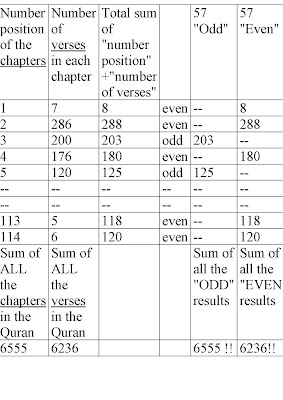
This week has been a very fruitful one in terms of the new information, sites and articles which I have found.
This post is by FAR different from my previous posts as it contains something that even now that I'm typing it I find really hard to grasp.
As You all probably know one of the reasons for the existence of different versions of the Bible and the Talmud is the different outlooks held by the previous Rabbis or Priests concerning different aspects of these two religions which has unfortunately ( well I think it is unfortunate) lead to many changes taking place in the Talmud or the Bible and in the end in a sort of manipulation of the original text.
Amongst ALL these different versions a person looking for the Truth would like to be given or at least be able to find the ONE version which is the AUTHENTIC one. It is only reasonable to believe that NOT EVERY version of the Talmud or the Bible can be authentic and there should be the possibility of human error (as the Rabbis or Priests who have undertaken to interpret or perhaps change some segments were NOT prophets and therefore NOT immune to human error!)
With Islam the different denominations exist NOT due to these different interpretations or manipulations (as All denominations of Islam have the SAME Quran) but rather as a result of " who should inherit the guidance of Islam after prophet Muhammad's passing away."
The Shia believe that the leadership (of course no more prophet hood here, as Muslims believe that Muhammad was The Last Prophet and there would be no other prophet after him) of the Islamic society should be decided through heavenly guidance and believe that the chosen person should be one who is COMPLETELY FREE of ANY sort of SIN ( just as all the prophets were free of sin according to the Shia). Therefore they believed that the Lord himself has to choose the person and according to Shia sources, the prophet Muhammad -after divine inspiration-announced to his people the rightful person as his successor who would guide them and he was his cousin ALI. But after the prophet's passing away some of the influential people denied Ali the right of becoming the first "Imam" and selected a person in his stead, these people form the Sunni denomination in Islam. Therefore the major difference amongst Muslims is NOT the different versions of the Quran but rather the matter of choosing a successor.
Now All what I have written was an introduction for what I'm about to write now (I'm reaaally sorry for the long intro but I felt I had to give more explanation).
The Muslims believe and I think the Quran itself announces( I have to check out the exact chapter) that while the previous Holy Books of Judaism and Christianity for eg have been manipulated by mankind and therefore distorted some of the words of the Lord, NOTHING of the sort has happened for the Quran and shall actually NEVER happen and the muslims believe that this is a promise of the Lord to keep the Quran immune from manipulation.
Now for me it was very hard to just take these words for granted without seeing even the slightest form of some reason. By reading the Quran of course, one realizes that everything is somehow different from what any human being could write, But I had my doubts as to whether ALL these years after the revelation to Prophet Muhammad there could not occur some small forms of change and manipulation, some segments taken out and erased for example or other segments added and changed.
What I have actually found out on August 27th 2008 is something I can just call EXTRAORDINARY!!
This was most probably not known to the world until 4 or five years ago ( I don't know the exact date but I have to search and find out) PLEASE READ VERY CAREFULLY:
A recent research of the Quran using minimum requirements such as a calculator has lead to stupefying results in calculations of some numbers which I can just call MIRACLE NUMBERS (see if you can find anything else to call them)
By the way, anyone can do the same, all you'll need is a calculator and a copy of the Quran.
If you look at the table of contents in the Quran, you'll find that there are 114 chapters of various lengths.
Now if you look at chapter One, you'll see that it only consist of seven verses, chapter two has 288 verses and so on.
what you need to do is to add the number position of each chapter with its number of verses. For example the first chapter: chapter 1+7(verses); Chapter 2+286(verses)…
You will notice that Miraculously what you get is exactly 57 "even" results and yes exactly 57 "odd" results!!!
But the amazing surprise continues:
*If we add up all our "even" results what we get is a number which is exactly the same as the total number of ALL the verses in the Quran!!!! 6236
AND….
*If we add up all our "odd" results what we get is a number which is exactly the same as the total number of ALL the chapters in the Quran!!!! 6555
See for yourself by using a calculator, a sheet of paper and a pencil. You'll need nothing more!
Note:
I don't really know what the odds are of somebody writing a whole book of about 500 pages( Keep in mind that Prophet Muhammad was ILLITERATE prior to prophethood!!!) in which everything is closely interwoven and completely makes sense, full of different genres such as stories, supplications, prayers, warnings…. and at the same time organize every break of thought or sentence in a way so that about 1000 something years later with the great extent of research done on the Quran, such carefully impossible categorization can be found in it!!!!
I can just exclaim: WOWWWWWWWWWWWWWWWWW!!!!!!!!
This table makes it easier to visualize:
Eagerly awaiting your helpful thoughts.
Wish you all a blessed day
Eli
Wish you all a blessed day
Eli
Subscribe to:
Posts (Atom)